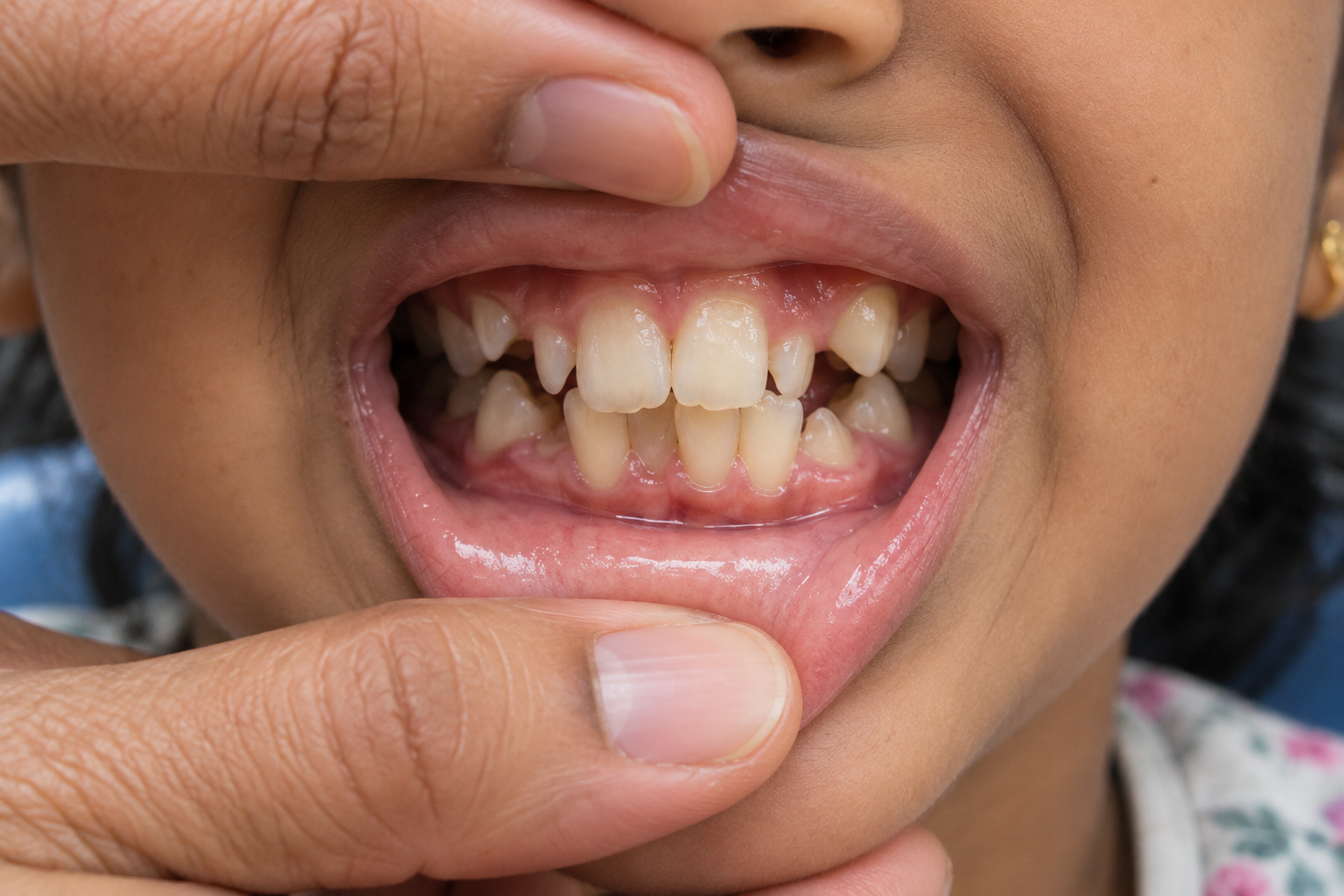
What Is Interceptive Orthodontics?
Interceptive orthodontics (also called Phase 1 or early orthodontics) is treatment that begins during the mixed dentition stage when a child still has some baby teeth but permanent teeth are actively erupting. This typically falls between ages 7 and 10.
The goal is not to straighten all the teeth (that comes in Phase 2, usually at age 11–14). Instead, Phase 1 focuses on correcting skeletal problems jaw width, jaw position, and bite relationships while the jaw is still malleable and responsive to gentle guidance. Once growth is complete, these corrections require jaw surgery or are simply impossible to achieve with braces alone.
The jaw grows most rapidly between ages 7 and 12. Applying orthodontic guidance during this period when bone is actively forming and remodelling is dramatically more effective than attempting the same corrections in a 16-year-old whose growth has stopped. This is why the American Association of Orthodontists recommends an orthodontic evaluation for every child by age 7.
What Conditions Benefit From Early Treatment
Not every child needs Phase 1 treatment many are best served by waiting for all permanent teeth before beginning braces. But certain conditions respond dramatically better when treated early:
What Phase 1 Treatment Involves
Phase 1 appliances are quite different from traditional braces. The most common include:
- Palate expander (RPE) a fixed appliance attached to the upper molars, with a central screw that parents turn daily to gradually widen the palate. Treatment duration: 6–12 months, followed by a retention period.
- Functional appliances (e.g., Twin Block, Herbst) removable or fixed devices that reposition the jaw and stimulate growth in specific directions. Used for overbite and underbite correction.
- Space maintainers when baby teeth are lost early, these hold the space open for the permanent tooth to erupt correctly.
- Partial braces sometimes just the front 4–6 teeth are bonded to guide eruption while the back teeth remain unbonded.
- Reverse pull headgear (facemask) for underbite correction; worn primarily at night.
Usually not. Most children who have Phase 1 treatment still need Phase 2 (full braces) once all permanent teeth have erupted, typically at age 11–13. However, Phase 1 reduces the complexity, duration, and cost of Phase 2 and achieves results that cannot be obtained in Phase 2 alone. Think of Phase 1 as laying the foundation so Phase 2 can build on solid ground.
Getting Your Child Evaluated
An orthodontic evaluation at age 7 does not automatically mean treatment. In our clinic, approximately 40% of children evaluated at this age are told to monitor and return at age 10–11 their development is on track and early intervention isn't warranted.
The evaluation itself involves a clinical examination, a panoramic X-ray to assess tooth development, and a cephalometric X-ray to measure jaw relationships. It takes about 30 minutes and gives us a complete picture of where your child's development stands.
An age-7 evaluation either catches a problem at the ideal time to fix it or gives you confirmed reassurance that everything is developing normally. There is no downside to getting evaluated. There is significant downside to waiting and finding out at 16 that an easily-treatable problem has become a surgical case.
Our orthodontic consultations include clinical examination and a report. Call +91 99452 25971 or book online. If your child is between 6 and 10 and hasn't had an orthodontic assessment, now is the time.