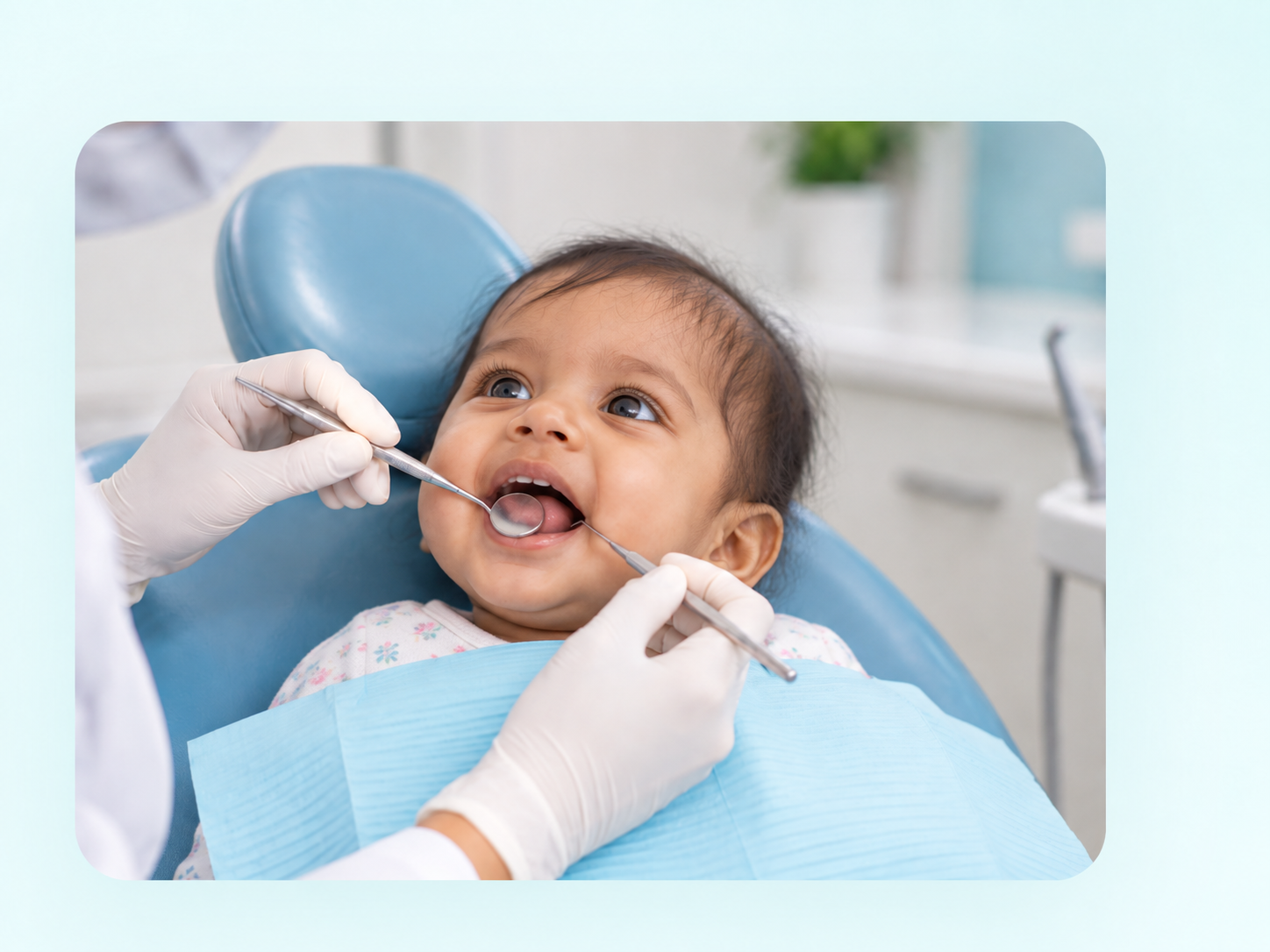
The first dental visit is not about the teeth — it is about establishing trust. A child who has a positive first experience at the dentist becomes a confident, cooperative patient for life. A frightening one can create anxiety that persists into adulthood. Getting the timing and approach right matters enormously.
When Should My Child First See a Dentist?
The Indian Academy of Pediatric Dentistry recommends the first dental visit by the child's first birthday — or within 6 months of the first tooth appearing, whichever comes first. This is not too early. It is exactly right.
- Clinical examination — we check that the erupting teeth and gums are healthy, that the bite is developing normally, and that there are no early signs of cavities.
- Early childhood caries check — ECC (baby bottle tooth decay) can begin as soon as teeth appear. Early detection means treatment is simple; left undetected, it spreads rapidly.
- Feeding and diet counselling — we discuss the impact of nighttime bottle feeding, juice, and sweetened foods on your infant's teeth.
- Positive introduction — an early first visit builds familiarity with the environment, the sounds, and the people, so the first "real" check-up is never a shock.
- Dental home — establishing a regular dental home early means your child has a trusted team to turn to for any concern, not just emergencies.
What Happens at the First Visit
Knee-to-Knee Examination
For very young children, we use a gentle knee-to-knee position: the parent sits facing Dr. Sugandh, with the child on the parent's lap. The child tips back so their head rests on the dentist's knee. This keeps the child close to the parent, who maintains eye contact throughout, while giving us a full view of the mouth. It is warm, unhurried, and reassuring rather than clinical.
What We Check
- Gum and tooth health — any redness, swelling, or early decay spots.
- Bite development — whether the jaws are growing symmetrically and the teeth are coming through in the right positions.
- Frenum attachments — we check for tongue tie or lip tie that may be affecting feeding or speech.
- Habits — thumb sucking, dummy use, and bottle habits are gently discussed.
- Fluoride status — we assess whether topical fluoride would benefit the child based on their cavity risk.
Parent Counselling
Much of the first visit is a conversation with you. We discuss tooth-brushing technique for small children, which toothpaste to use and how much, what to do if a tooth is knocked out, what foods carry the highest cavity risk, and when to expect the next teeth to arrive. You leave with a clear, written plan.
Preparing Your Child
- Choose words carefully — say "the dentist will count your teeth" rather than "it will not hurt." Anticipating pain before mentioning it plants the idea.
- Avoid negative language — words like "injection," "drill," "hurt," and "scared" should not appear in pre-visit conversations, even if you are trying to reassure.
- Read books together — there are excellent children's books about first dental visits that frame it as an exciting adventure.
- Play dentist at home — counting each other's teeth with a small mirror takes the mystery out of the examination.
- Time it well — morning appointments when the child is rested work far better than late-afternoon slots when they are tired and hungry.
- Stay calm yourself — children sense parental anxiety. Your calm confidence is the most powerful preparation tool there is.
Frequently Asked Questions
Related concerns: