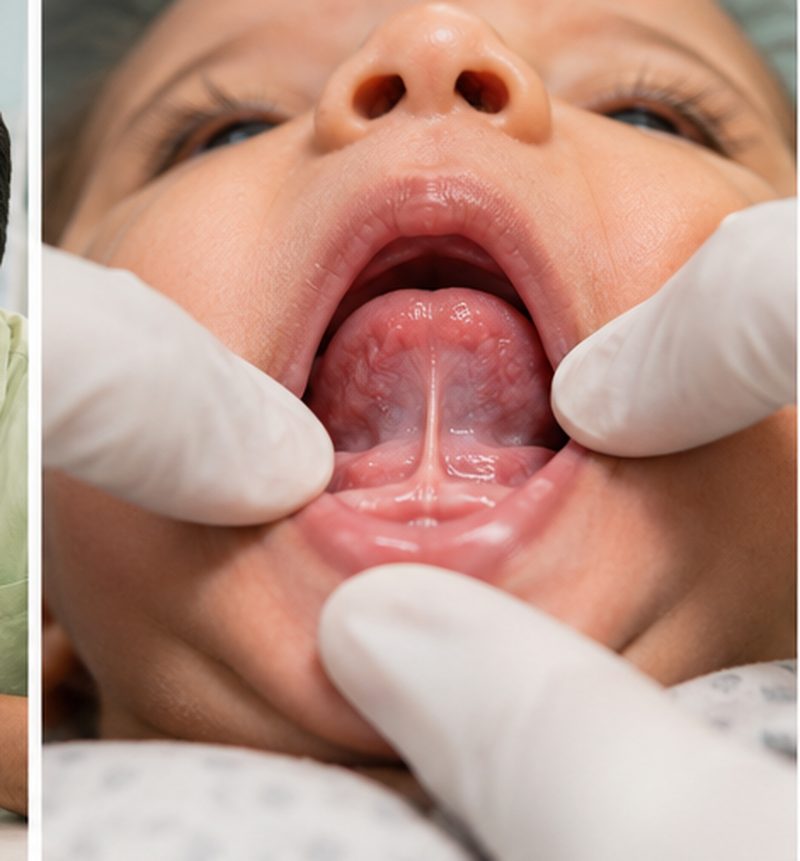
How Tongue Tie Presents at Each Stage
Newborns
- Difficulty latching onto the breast or bottle
- Clicking or smacking sound during feeding
- Frequent feeding with poor weight gain
- Nipple pain or damage in the breastfeeding mother
- Baby becomes easily frustrated and fatigued during feeds
- Excessive wind or colic due to air swallowing during feeding
Toddlers — Age 1–3
- Difficulty moving food around the mouth and clearing food from teeth
- Preference for soft or pureed foods beyond the expected age
- Delayed first words or early speech that is difficult to understand
- Difficulty making certain sounds, particularly "t", "d", "n", "l", "r"
Pre-school — Age 3–6
- Lisping or unclear speech noted by parents or nursery teachers
- Cannot lick an ice cream, stick out the tongue, or touch the roof of the mouth
- Tongue cannot elevate beyond the lower teeth when the mouth is open
- Heart-shaped or notched appearance at the tip of the tongue
- Open mouth posture and habitual mouth breathing
Older Children and Teens
- Persistent speech difficulties despite speech therapy
- Gap between the two lower front teeth caused by lip tie
- Difficulty swallowing certain foods or textures
- Jaw pain or tension due to compensatory muscle patterns
- Orthodontic relapse — braces work but teeth drift back — often linked to tongue posture
Lip Tie — The Often-Missed Companion Condition
A lip tie occurs when the upper lip frenulum (the tissue connecting the upper lip to the gum) is too tight, restricting lip movement. It frequently occurs alongside tongue tie and can cause its own set of issues:
- Poor latch in newbornsThe upper lip cannot flange (curl outward) properly during breastfeeding.
- Midline gap in upper front teethA diastema that may persist after the baby teeth are replaced by permanent ones.
- Higher cavity riskDifficulty cleaning the upper front teeth leads to plaque accumulation in that area.
LASER vs Conventional Frenectomy
| Feature | LASER Frenectomy | Conventional (Scissor/Scalpel) |
|---|---|---|
| Stitches required | None | Usually required |
| Bleeding | Minimal — LASER seals as it cuts | More significant |
| Procedure time | 5–15 minutes | 15–30 minutes |
| Post-procedure pain | Very low | Moderate |
| Recovery time | 24–72 hours | 5–10 days |
| Anaesthesia | Topical only (for infants) | Local injection required |
| Risk of reattachment | Lower | Higher |
What to Expect at Your Appointment
Assessment Visit
At the first appointment, Dr. Mittal performs a thorough functional assessment — not just a visual check. We evaluate the degree of restriction, the functional impact on feeding or speech, the child's age and cooperation, and whether any additional therapy (speech, feeding, myofunctional) is needed alongside the procedure.
The Procedure
For infants, topical anaesthetic gel is applied and the procedure takes less than 5 minutes. For older children, a small amount of local anaesthetic is given first, after which the LASER releases the frenulum in a precise, controlled movement. The child may feel mild pressure but no pain. The area looks white immediately after — this is normal healing tissue, not a wound.
Aftercare
For newborns, breastfeeding can resume immediately. We provide a simple stretching exercise programme to perform at home for 2–3 weeks to prevent reattachment and help the tongue establish new movement patterns. Older children may need to resume speech therapy or myofunctional exercises after healing.
Immediately after LASER frenectomy, the treated area appears white. This is healthy healing tissue — similar to a mouth ulcer healing. It is not a wound or an infection. It resolves within 7–10 days. Do not be alarmed by this appearance.
What Parents Say
"My daughter was 3 weeks old and I was in agony at every feed. Three people had told me her tongue tie was 'mild.' Dr. Mittal assessed her for 15 minutes and said it was functional. The procedure took 6 minutes. She latched differently at the very next feed."
"My son had been in speech therapy for 18 months. Dr. Mittal released the tongue tie. Four months later, he produced his first clear 'l' sound. His therapist called us. She was not surprised."