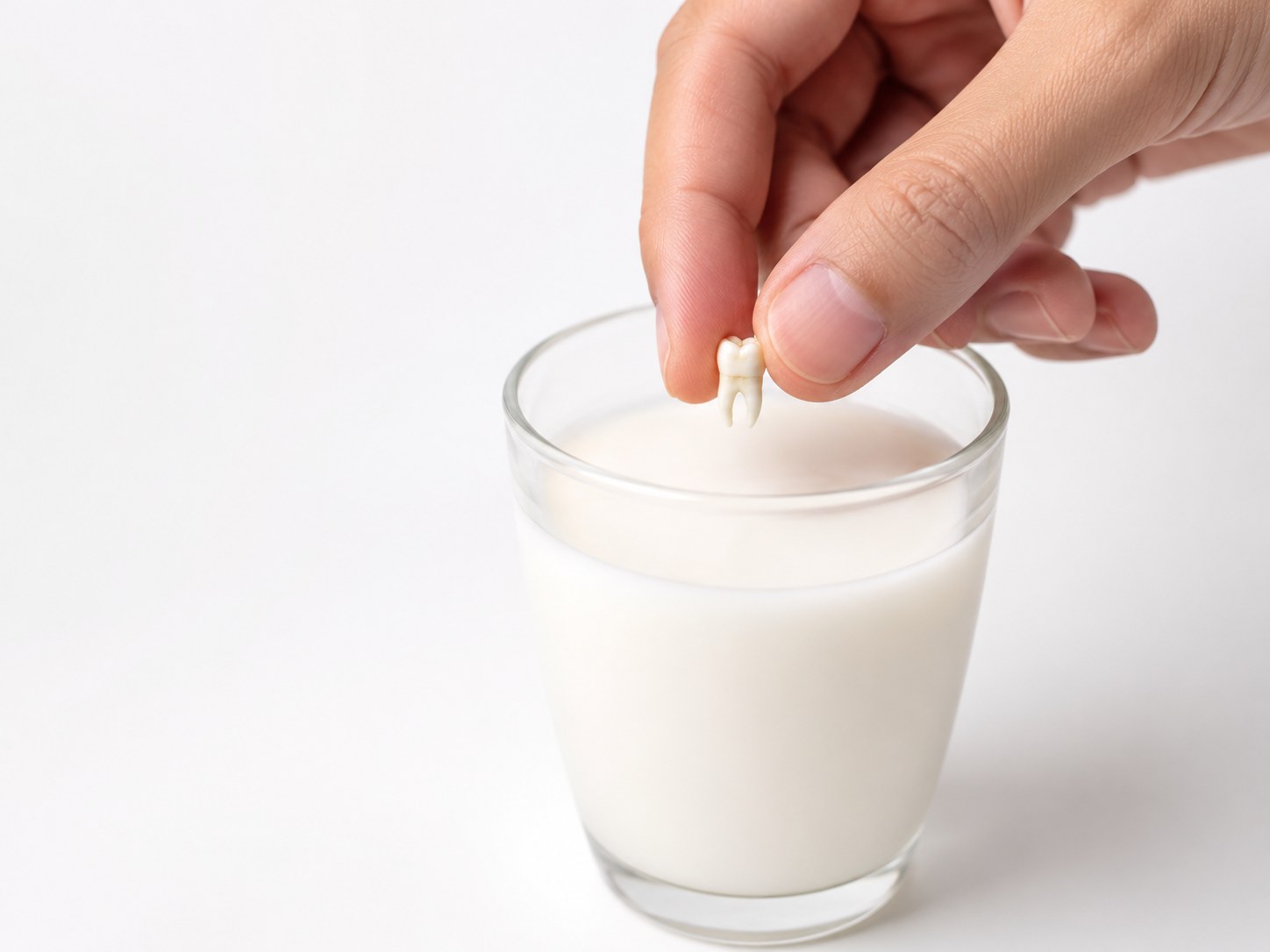
🚨 Dental Emergency — Act Within 30 Minutes
A permanent tooth knocked out has the best chance of survival when reinserted within 30 minutes. Call us immediately: +91 99452 25971
What to Do Right Now
- Find the tooth — hold it by the crown (white part), never by the root.
- Do not scrub the root — the periodontal ligament fibres on the root surface are essential for reattachment. Rinse gently with cold water only if visibly dirty.
- Reinsert if possible — gently push the tooth back into its socket and have the child bite on a clean cloth. This is the best storage medium.
- If reinsertion is not possible — store in cold whole milk or the child's own saliva. Never use water, tissue, or dry storage.
- Call us immediately — we will see you right away, no appointment needed.
Important: Baby Teeth Are Different
Do not attempt to reimplant a knocked-out baby tooth. Forcing it back can damage the developing permanent tooth underneath. Bring the child in so we can assess the socket and monitor development.
Golden Window
30 min
For permanent tooth reimplantation
Best Storage
Milk / Saliva
If reinsertion not possible
Splint Duration
2–4 weeks
After reimplantation
Follow-Up
1 mo → 1 yr
Regular monitoring post-trauma
Types of Dental Trauma
- Chipped / Fractured Crown — The most common injury. Small chips may only need smoothing or bonding; deeper fractures involving the nerve need urgent assessment.
- Luxation (displaced tooth) — The tooth is still in the socket but pushed inward, outward, or sideways. Do not attempt to reposition it yourself; come in immediately.
- Avulsion (completely knocked out) — The most critical injury. Time to reimplantation is everything.
- Root Fracture — The fracture is within the bone, invisible on examination. Only an X-ray can confirm. Splinting and monitoring are usually required.
- Alveolar (socket bone) Fracture — The supporting bone itself is broken. This requires specialised stabilisation and close follow-up.
What We Do at the Clinic
- Immediate assessment — we examine the tooth, socket, and surrounding tissues as soon as you arrive.
- Reimplantation — the tooth is gently reinserted and repositioned under local anaesthesia if needed.
- Splinting — a flexible splint bonds the tooth to neighbouring teeth for 2 to 4 weeks, allowing healing while permitting natural movement.
- X-rays — baseline radiographs are taken to assess root and bone status.
- Pulp monitoring — we check vitality at each follow-up; root canal treatment is initiated if the nerve does not survive, preventing infection.
- Follow-up schedule — reviews at 1 week, 1 month, 3 months, 6 months, and 1 year ensure we catch any complications early.
Frequently Asked Questions
It can, especially when reimplanted within 30 minutes and properly cared for. However, resorption (root dissolving over time) is a known risk. Regular monitoring gives us the best chance of a long-term outcome.
Yes. While we don't reimplant baby teeth, we need to check that the socket is clean, no fragment remains, and the permanent tooth bud underneath is undamaged. We will also advise on monitoring for eruption of the permanent tooth.
Intrusion is one of the more serious injuries because it can crush the bone and the developing permanent tooth. Do not attempt to pull it back out. Come in immediately for assessment and X-rays.
No — tap water kills the periodontal ligament cells within minutes due to differences in osmotic pressure. Use cold whole milk or saliva as storage if the tooth cannot be reinserted immediately.
Often yes, especially for teeth with fully formed roots. Root canal treatment is usually started 7 to 14 days after reimplantation to prevent infection and resorption. For teeth with open apices (immature roots), we monitor to see if the pulp revascularises on its own.
Related concerns: