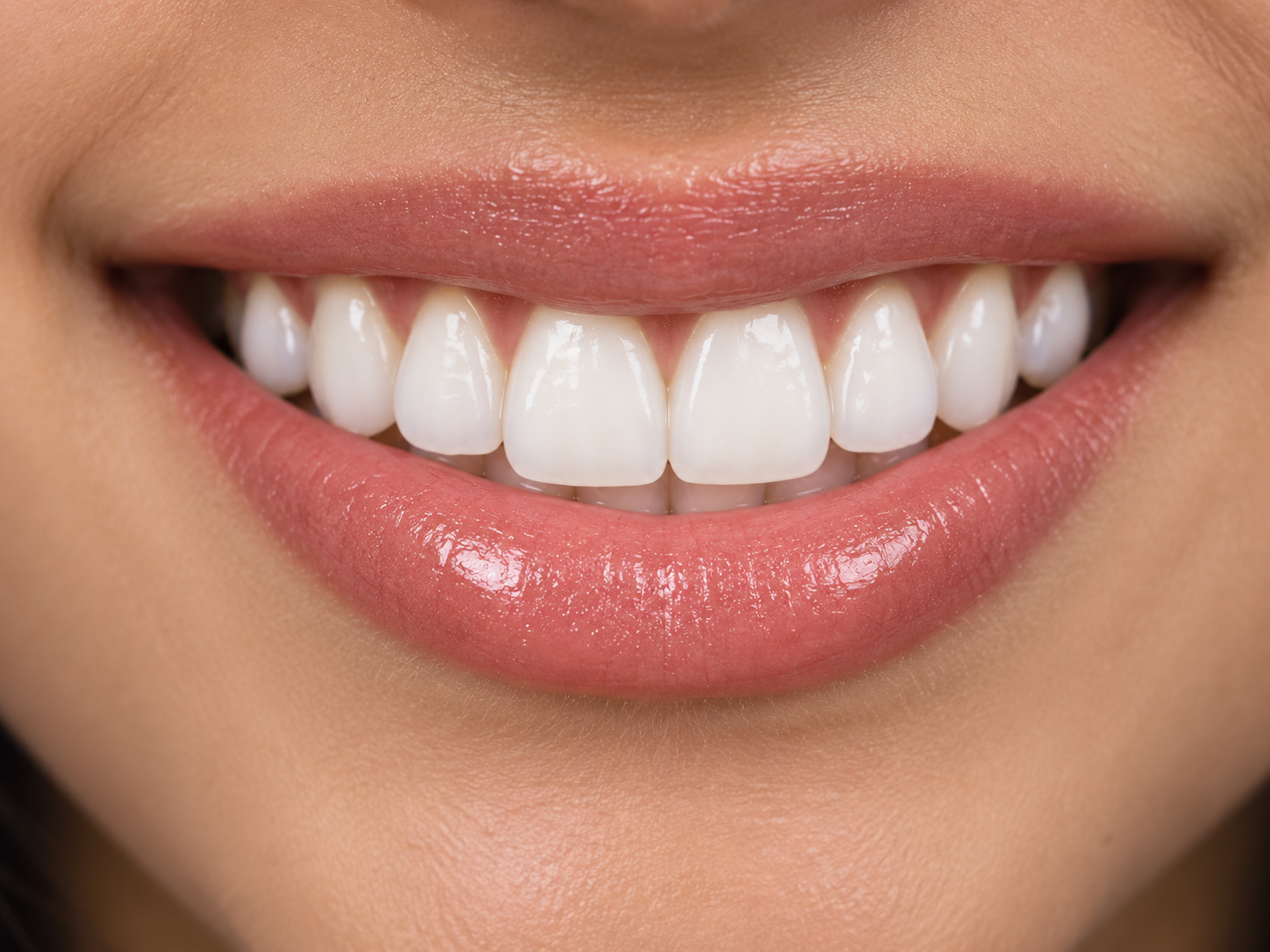
When Are Veneers Appropriate?
- Fluorosis or tetracycline staining — intrinsic discolouration that bleaching cannot fully correct.
- MIH (Molar Incisor Hypomineralisation) — white or brown patches on front teeth that affect appearance and cause sensitivity.
- Chipped or fractured front teeth — trauma-related chips where the tooth structure is sound but the appearance is affected.
- Peg laterals or small teeth — congenitally small or abnormally shaped lateral incisors that leave gaps or asymmetry.
- Mild spacing — small gaps between front teeth (diastemas) that cannot or need not be closed with braces.
We recommend waiting until a teenager's smile has fully developed — typically 16 for girls, 17–18 for boys — before placing permanent veneers, so that the final tooth position and gum level are stable.
Composite vs Porcelain Veneers
Direct Composite Veneers (Single Visit)
Tooth-coloured composite resin is bonded directly to the tooth and sculpted to the desired shape in a single appointment. Little or no enamel removal is required. Composite veneers can be repaired easily if chipped. They are an excellent first choice for teenagers — reversible, fast, and can be upgraded to porcelain at a later stage.
Porcelain Veneers (Lab-Fabricated)
Porcelain veneers are thin ceramic shells fabricated in a dental laboratory and bonded to the teeth in a second appointment. They offer superior aesthetics and stain resistance, and are more durable than composite. A thin layer of enamel is usually removed for placement.
What Parents Say
“My daughter had discoloured teeth from a childhood medication. Composite veneers transformed her smile completely. The work was meticulous and she gained so much confidence back at school.”
“The team was very honest about what veneers can and cannot do. They suggested composite first before committing to porcelain. Three years in, they still look great with no further work needed.”
“Getting veneers at 18 was my daughter’s decision. Dr. Mittal managed it beautifully — explained each step, showed digital previews before committing. The result exceeded all our expectations.”
Frequently Asked Questions
Composite veneers typically require no enamel removal at all. Porcelain veneers require a thin layer (0.3–0.5 mm) of enamel to be removed — which is why we prefer composite for younger teenagers and reserve porcelain for cases where the aesthetic goal cannot be achieved otherwise.
Veneers can improve the appearance of mildly misaligned or rotated teeth by masking the angle. For moderate or significant crowding, orthodontic treatment is the correct first step — veneers on misaligned teeth would require excessive tooth reduction. We assess each case individually and will be honest about what veneers can and cannot achieve.
Veneers are not appropriate for children whose teeth are still developing. We generally recommend waiting until at least 18 years — ideally until jaw growth is complete. In teenagers, composite (tooth-coloured resin) veneers can be placed as a conservative interim option. Placing permanent porcelain veneers too early risks misalignment as the jaw continues to develop.
Porcelain veneers typically last 10 to 15 years with good care. Composite veneers last 5 to 7 years. Longevity is affected by grinding, biting on hard foods, and oral hygiene. Patients who grind their teeth are fitted with a night guard to protect their veneers. Regular check-ups allow us to monitor veneer margins and surface wear.
Porcelain veneers involve a small but permanent reduction of enamel to accommodate the veneer’s thickness — once placed, the tooth will always need a covering. Composite veneers are more conservative and largely reversible. For patients who are unsure, composite is the right starting point. We discuss the degree of tooth preparation required before any veneer procedure is planned.