Why Do Baby Tooth Spaces Matter?
Baby teeth are not just temporary placeholders — they actively hold space in the dental arch for the permanent teeth developing beneath them. When a baby tooth is lost prematurely (before the adult tooth is ready to erupt), the surrounding teeth begin to drift into the vacant space within weeks. This can:
- Block the path of the erupting permanent tooth, causing impaction or ectopic (abnormal) eruption
- Create crowding that requires much more extensive orthodontic treatment later
- Cause the arch to narrow, contributing to the need for extractions of permanent teeth
- Result in mid-line shifts (the centre of the smile moving to one side)
The solution is simple: a space maintainer placed immediately after the premature loss holds the gap open until the permanent tooth is ready to erupt naturally.
When is a Space Maintainer Needed?
Not every early baby tooth loss requires a space maintainer. We evaluate:
- Which tooth was lost (front teeth vs. back teeth — back teeth are more critical for space maintenance)
- The age of the child and the estimated eruption time of the adult tooth (based on X-ray)
- Whether adjacent teeth have already drifted
- The overall arch length and crowding situation
As a general guideline: if the permanent tooth is more than 12 months from eruption, a space maintainer is recommended.
Types of Space Maintainers
Band & Loop (Most Common)
A stainless steel band is cemented around the tooth adjacent to the gap. A loop of wire extends from the band across the empty space and rests against the next tooth. Simple, durable, and effective for a single missing tooth.
Nance Appliance
Used when multiple teeth are missing in the upper arch. Bands on the upper first permanent molars are connected by a wire that crosses the palate and rests on an acrylic button at the front. Prevents the molars from drifting forward.
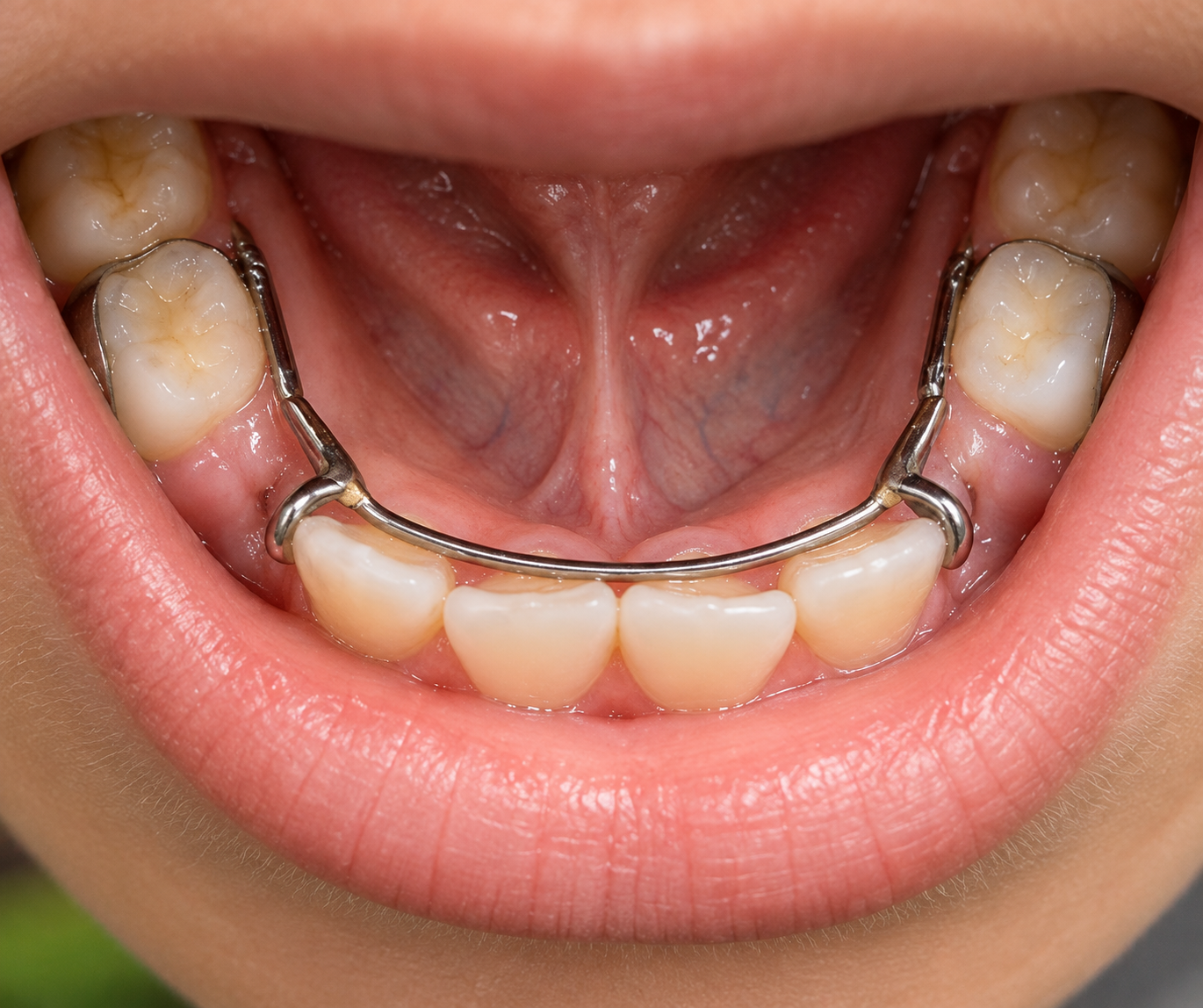
Lingual Arch (LLA)
A fixed appliance connecting the lower first permanent molars via a wire that runs along the inside (lingual) surface of the lower arch. Used when multiple lower teeth are lost prematurely or when generalised space management is needed.
Distal Shoe
A specialised appliance used when the second baby molar is lost before the first permanent molar has erupted. The appliance extends under the gum line to guide the erupting permanent molar into its correct position. Requires careful monitoring.
Frequently Asked Questions
Front tooth (incisor) loss rarely requires a space maintainer, because the neighbouring teeth (canines and other incisors) are relatively resistant to drifting into small front gaps. However, we still assess each case individually. A flipper (a removable cosmetic replacement tooth) may be offered for aesthetic reasons and self-confidence if the gap will be open for a long time.
The surrounding teeth will begin to drift within weeks. Depending on how much drift occurs before the permanent tooth erupts, the consequences range from mild crowding (easily corrected with braces) to complete closure of the space, requiring complex orthodontic treatment to reopen. The older the child and the more time elapses without a maintainer, the greater the drift.
No. Placement is quick and straightforward — typically one appointment. There may be minor sensitivity for 24–48 hours as the child adjusts to the appliance, but space maintainers are comfortable to wear. We advise avoiding sticky foods (toffee, gum) that can loosen the band.
We monitor the eruption of the permanent tooth every 6 months on X-ray. When the permanent tooth is clearly emerging through the gum, we remove the space maintainer. Removal is simple — typically done in a single short appointment.