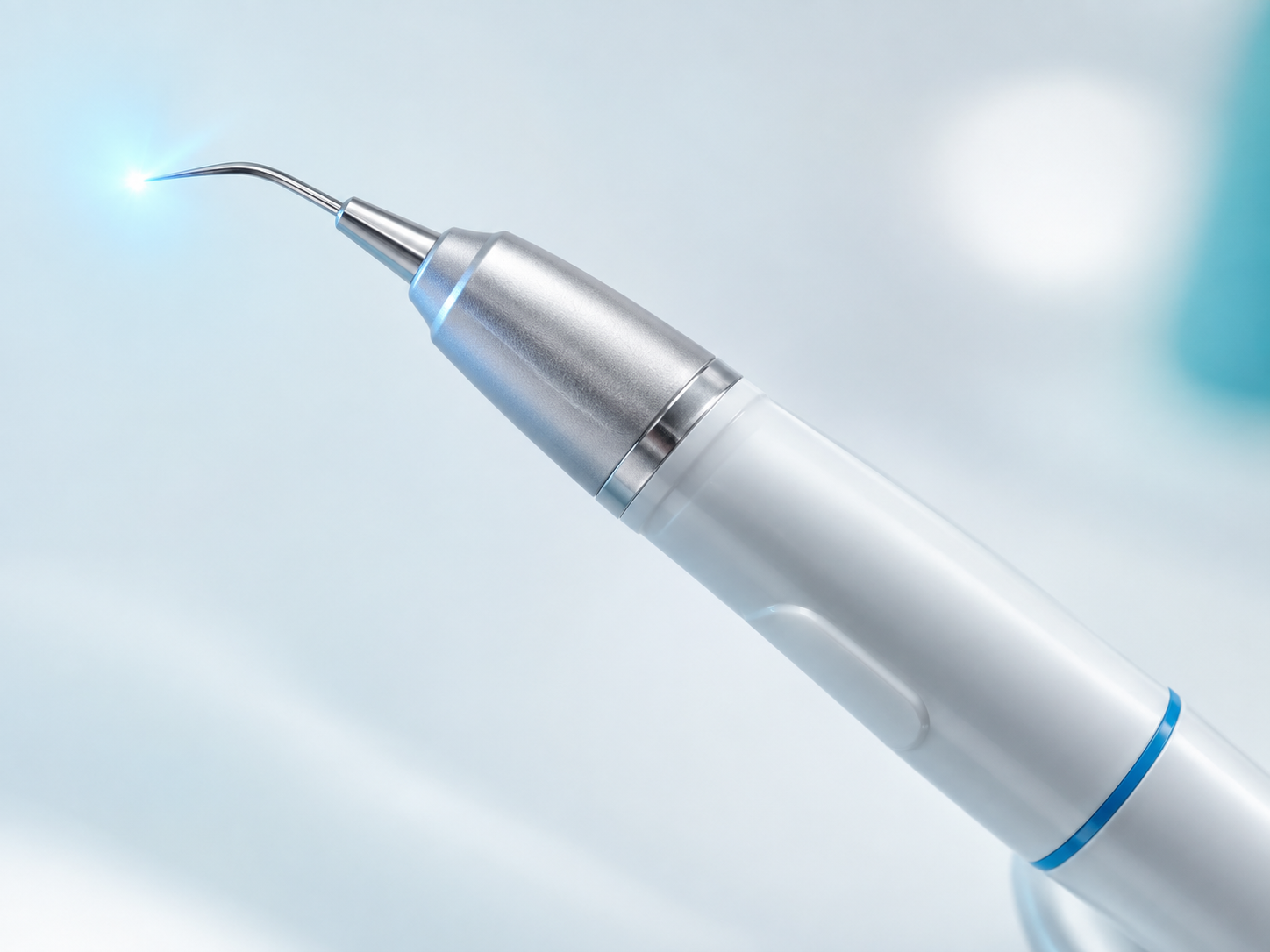
What Is LANAP?
LANAP stands for Laser-Assisted New Attachment Procedure. It is the only scientifically proven, FDA-cleared protocol that achieves true periodontal regeneration — new bone, cementum, and ligament — using a LASER rather than a scalpel.
The specific wavelength used (typically 1064 nm Nd:YAG) is selectively absorbed by the pigmented, diseased tissue and by the bacteria that cause periodontal disease. Healthy pink tissue reflects this wavelength and is left undisturbed. The result is bacterial elimination, removal of diseased tissue, and stimulation of regeneration — all without a single cut.
Who Benefits From LANAP?
- Children and teens with early periodontitis — aggressive juvenile periodontitis can cause rapid bone loss; LANAP arrests progression and allows regeneration.
- Special needs patients — children with Down syndrome, cerebral palsy, or those on medications that cause gingival inflammation benefit from a non-invasive, shorter-appointment protocol.
- Patients with deep pockets — pockets deeper than 4 mm that do not respond to scaling and root planing alone are candidates for LANAP.
- Patients who are medically complex — the absence of incisions significantly reduces bleeding risk and infection risk for children on anticoagulants or immunosuppressants.
LANAP vs Conventional Surgery
Conventional periodontal surgery requires flap elevation, suturing, and 2–4 weeks of healing. LANAP achieves comparable or superior results with a 24–48 hour recovery and no post-operative dietary restrictions beyond the first day.
What to Expect
- Initial assessment — full periodontal charting and X-rays to map bone levels and pocket depths before treatment.
- Local anaesthesia — the area is numbed; the LASER fibre is gently inserted into each pocket.
- LASER pass 1 — bacteria and diseased tissue are vaporised selectively.
- Ultrasonic scaling — root surfaces are cleaned of calculus deposits.
- LASER pass 2 — a blood clot is formed at the base of each pocket, sealing it and initiating regeneration.
- Bite adjustment — occlusal forces are balanced to reduce stress on healing tissues.
What Parents Say
“My teenager had severe gum disease — we thought surgery was unavoidable. LANAP meant no cut, no stitches, and she was eating normally within two days. The gum health at the 3-month check was remarkable.”
“My son has Down syndrome and traditional gum surgery would have been very difficult to manage. LANAP was the right choice — minimal trauma, fast recovery, and he coped exceptionally well throughout.”
“My gum disease had progressed to bone loss. Dr. Mittal explained LANAP could regenerate some of that bone — and the 12-month X-ray showed real measurable improvement. I was genuinely surprised.”
Frequently Asked Questions
Yes — LANAP is the only periodontal procedure with histological proof of true regeneration (new bone, new cementum, new periodontal ligament). Multiple peer-reviewed studies and FDA clearance confirm this. Results vary by patient and severity of disease, and we will give you a realistic assessment at consultation.
Yes, particularly for aggressive juvenile periodontitis, Down syndrome-associated periodontal disease, or medically complex children where conventional surgery carries additional risk. The non-invasive nature makes it well-tolerated even in anxious or special-needs patients.
Clinical improvement — reduced probing depths, less bleeding, and smaller pocket sizes — is typically measurable at the three-month recall appointment. Radiographic evidence of bone fill, where it occurs, develops over 6 to 12 months. Full stabilisation of the periodontium takes around 12 months, after which maintenance every 3 to 4 months is essential to sustain the improvement.
LANAP achieves significant clinical improvement and, in suitable cases, bone regeneration — but it does not eliminate the underlying susceptibility to periodontitis. Without regular maintenance, bacterial biofilm re-accumulates and disease can recur. Patients who maintain 3-monthly hygiene appointments and excellent home care after LANAP can sustain a healthy periodontium long-term. LANAP is the beginning of an ongoing maintenance programme, not a one-time procedure.
LANAP is not suitable for patients with uncontrolled diabetes (impaired wound healing), those on anticoagulant medications without medical clearance, active oral ulcers or infections in the treatment zone, or cases where bone loss is so advanced that retaining the teeth is not clinically viable. A comprehensive assessment including full-mouth probing depths and up-to-date radiographs determines eligibility at the consultation appointment.
No. LANAP is performed in combination with thorough scaling and root planing, not as a substitute for it. The laser step follows comprehensive debridement: it selectively removes diseased tissue lining the pockets, kills residual bacteria, and stimulates a blood clot that promotes tissue reattachment. LANAP without thorough scaling would not achieve the same clinical outcomes.