Which Habits Require Dental Intervention?
Not all oral habits cause dental damage. The habits that require dental assessment and often appliance intervention are:
- Thumb or finger sucking — Persistent beyond age 4 with high intensity. Creates open bite, protruded upper teeth, and narrow arch.
- Tongue thrusting — The tongue pushes forward against or between the front teeth during swallowing (rather than pressing against the palate). Maintains open bite and can resist orthodontic correction if untreated.
- Dummy (pacifier) sucking — Beyond age 3. Creates similar dental effects to thumb sucking, though generally milder and more controllable.
- Lip sucking or biting — Repeated trapping of the lower lip between the front teeth increases overjet and puts pressure on the chin.
Counselling-First Approach
Before placing any appliance, we always attempt behavioural management. Many children stop harmful habits successfully with:
- Parental guidance on positive reinforcement strategies (reward charts, sticker systems)
- Identifying emotional triggers (anxiety, boredom, tiredness) and providing alternative coping strategies
- A "contract" with the child (age-appropriate for children over 5) where they commit to stopping
- Simple reminders such as a Band-Aid on the thumb at night — not punitive, just a physical cue
If these approaches fail after 2–3 months, or if dental changes are already progressing rapidly, we move to appliance therapy.
Types of Habit-Breaking Appliances
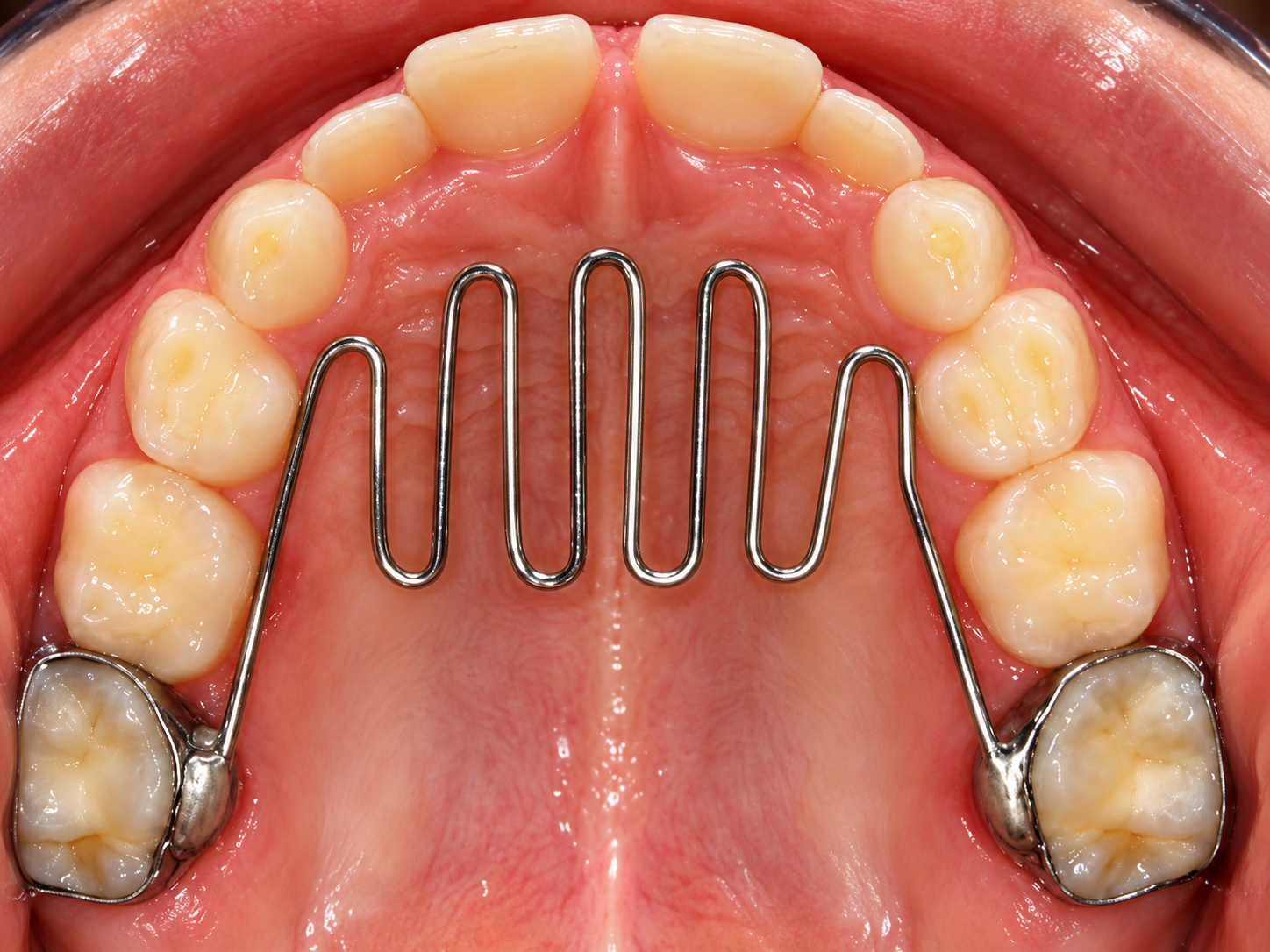
Palatal Crib (Thumb Crib / Rake)
A fixed appliance cemented to the upper back teeth with a series of vertical or angled wires (the "crib" or "rake") extending across the palate. When the thumb is placed in the mouth, it encounters the wires instead of the smooth palate — the sucking motion becomes unrewarding, and the habit is naturally extinguished within 4–6 weeks in most children. The crib is invisible when the child speaks or smiles. It is not painful.
Tongue Crib
A fixed appliance with a cage or grid of wires positioned behind the upper front teeth, preventing the tongue from thrusting forward between the teeth during swallowing. It physically redirects tongue position without pain and helps retrain the swallowing pattern over 6–12 months.
Lip Bumper
A removable or semi-removable acrylic shield that holds the lower lip away from the lower front teeth, reducing the pressure of lip-sucking and lip-trapping. Also used to gain mild lower arch space in certain cases.
Frequently Asked Questions
No. The appliances create a physical barrier or reminder — they are not designed to cause pain. Some children experience mild discomfort in the first 2–3 days as their tongue and lips adjust to the new appliance, and there may be temporary speech changes. Most children adapt fully within 1 week.
This is a common parental concern. Research and clinical experience consistently show that when the appliance is introduced with a positive explanation ("This is a helper to remind your mouth not to suck your thumb — not a punishment"), children accept it very well. It is important to involve the child in the decision. We never place an appliance without the child's understanding and, ideally, their agreement.
In young children (below age 7–8), significant self-correction of open bite and arch narrowing is expected once the habit stops — the teeth continue to move as the jaw grows, and the harmful force is removed. In older children, orthodontic correction may still be needed, but it is far more predictable once the habit is no longer actively working against treatment.
We typically keep the appliance in place for 6 months beyond habit cessation to ensure the habit pattern does not re-establish. After removal, we monitor for 3–6 months. Relapse is uncommon when the full protocol is followed, but if it occurs, the appliance is re-cemented promptly.