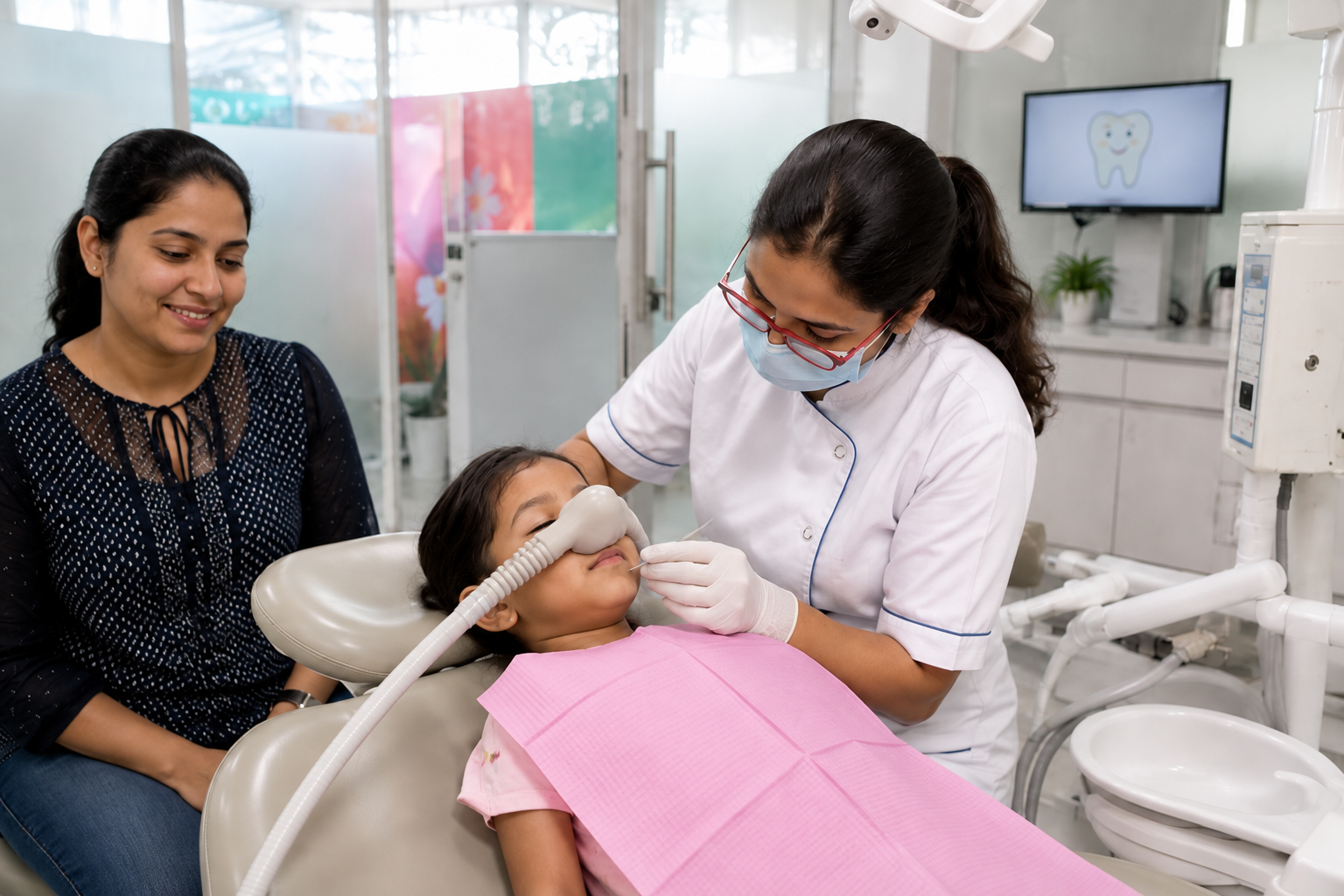
Sedation for children at the dentist is one of the most searched and most misunderstood topics in paediatric dental care. Parents have legitimate questions — is it safe, is it necessary, what are the risks, will my child be "put to sleep"? This article answers those questions directly, without the hedging that makes them harder to find elsewhere.
When Is Sedation Actually Necessary?
The honest answer: less often than some clinics suggest, and more often than anxious parents want to hear. Sedation is not the first response to a reluctant child — it is the last resort after structured behaviour management has genuinely failed. But for specific situations, it is genuinely necessary:
- Severe dental anxiety that does not respond to behavioural techniques after multiple visits
- Children under 3 with extensive decay requiring multiple teeth to be treated
- Special needs children (ASD, CP, intellectual disability) where the sensory demands of the appointment are genuinely overwhelming
- Strong gag reflex preventing even examination
- Multiple teeth requiring treatment simultaneously, where 4 separate traumatic visits would cause more harm than one calm sedated session
The red flag to watch for: a clinic that recommends GA or oral sedation at the first sign of resistance, without first trying structured desensitisation over 2 to 3 visits. That is not clinical necessity — it is convenience.
At Dr. Mittal's clinic, sedation is offered only after behaviour management has been genuinely attempted. Most children who resist on the first visit are cooperative within 2 to 3 structured visits when handled correctly.
Types of Sedation for Children
Nitrous Oxide (Laughing Gas)
The safest and most reversible option. A child-friendly nasal mask delivers a nitrous oxide and oxygen mix — the child stays fully conscious, responsive, and able to talk throughout. They feel relaxed, often warm or giggly. Effect onset: 3 to 5 minutes. Full recovery: 5 minutes after mask removal. No fasting required for routine procedures. Back to school the same day.
Oral Sedation (Midazolam)
A liquid medication given orally 30 to 45 minutes before the appointment. The child becomes drowsy and relaxed but remains conscious. Most children remember little or nothing of the appointment (midazolam has an amnestic effect). Requires fasting (no solids for 6 hours, no clear fluids for 2 hours). Recovery: 2 to 4 hours. A responsible adult must accompany the child and remain available. Cannot return to school the same day.
General Anaesthesia (GA)
Full unconsciousness in a hospital theatre with a specialist paediatric anaesthesiologist. All required treatment is completed in a single session. Pre-operative assessment including blood work is required. Recovery: 1 to 2 hours in supervised PACU. Same-day discharge in most cases. We coordinate with NABH-accredited paediatric hospitals in Bengaluru.
Is Sedation Safe for Children?
Yes — when administered by trained clinicians with proper monitoring equipment in an appropriately equipped facility. Nitrous oxide has one of the longest safety records of any medical intervention. Oral sedation with midazolam, administered at the correct weight-based dose with continuous monitoring, has a very low adverse event rate. GA carries the same risks as any general anaesthetic — low with proper pre-operative screening and expert anaesthesiology — but is categorically different from conscious sedation.
The risks increase with untrained administrators, incorrect dosing, inadequate monitoring, and inappropriate patient selection. The questions to ask: Is the doctor certified in conscious sedation? Is monitoring equipment present and operational? Is there a written emergency protocol? Is the dosing based on the child's current weight?