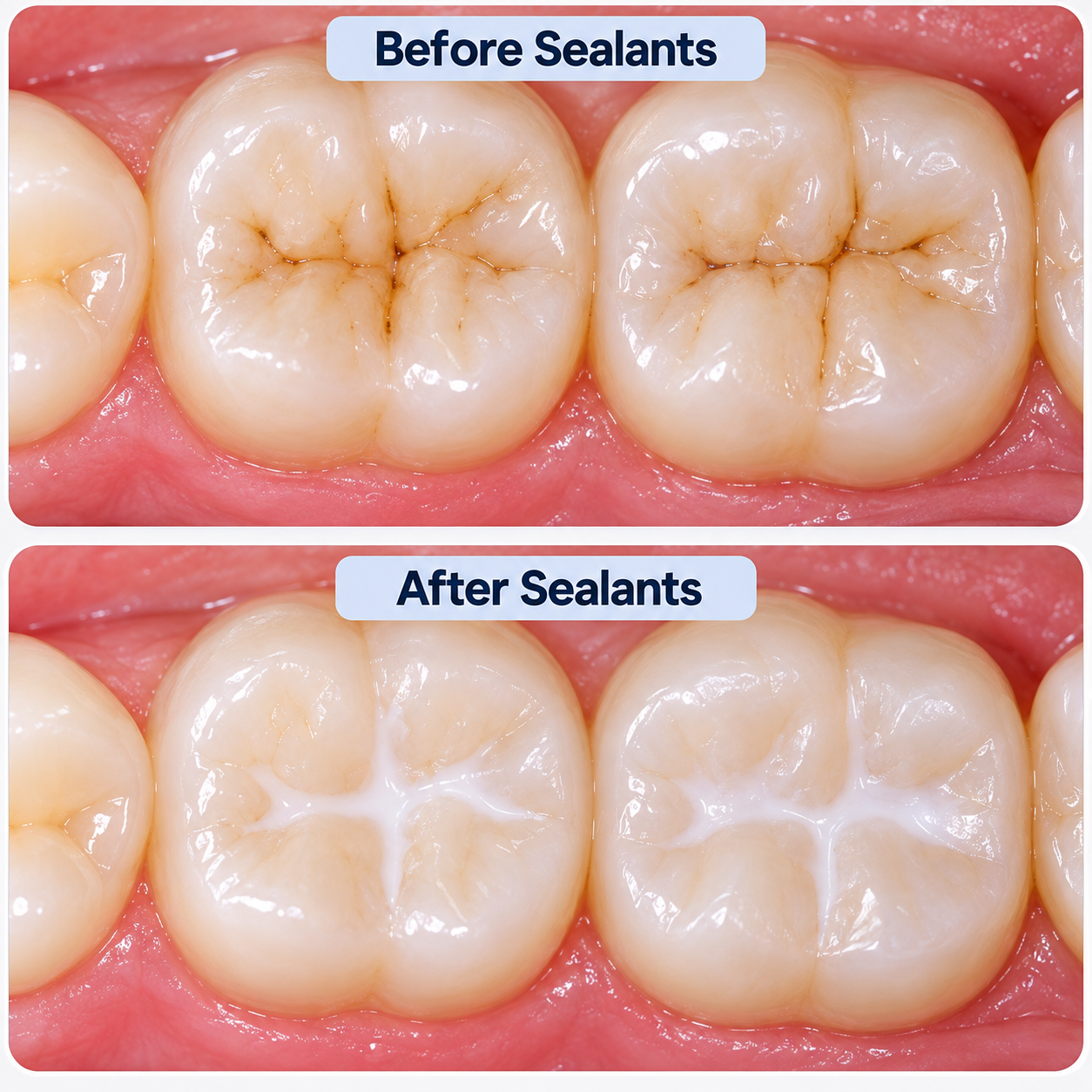
What Are Pit and Fissure Sealants?
Pit and fissure sealants are thin, protective plastic coatings applied to the chewing surfaces of the back teeth specifically the molars and premolars. These teeth have deep grooves (called pits and fissures) that trap food particles and bacteria, making them the most cavity-prone surfaces in a child's mouth.
Think of sealants as an invisible shield. When painted onto the tooth surface, the liquid sealant flows into every groove and crevice, then hardens under a special curing light to create a smooth, easy-to-clean surface. Bacteria no longer have anywhere to hide. Acids no longer have unprotected enamel to attack.
The procedure is entirely painless, requires no injections, no drilling, and no removal of tooth structure. It takes approximately 3–5 minutes per tooth and can be done as part of a routine check-up visit.
80% of cavities in school-age children occur on the chewing surfaces of the back teeth the exact surfaces that sealants protect. The CDC calls dental sealants one of the most effective preventive tools available, reducing the risk of molar decay by up to 80% in the first two years and continuing to protect for up to 4 years after placement.
Why Molars Are So Vulnerable
To understand why sealants are so valuable, it helps to understand the anatomy of a molar. Unlike front teeth, which have smooth, relatively flat surfaces, molars have complex chewing surfaces riddled with narrow grooves, pits, and fissures. These grooves can be so deep and narrow sometimes as thin as a single toothbrush bristle that even the most diligent brushing cannot reach the bottom.
Food residue and bacteria accumulate in these grooves throughout the day. Saliva, which normally helps neutralise acids, cannot reach the bottom of the deepest grooves. Fluoride from toothpaste also struggles to penetrate. The result? An environment where cavity-causing bacteria thrive, acids attack enamel, and decay begins often long before any visible signs appear.
Children are especially vulnerable for two reasons: first, their tooth enamel is newly erupted and not yet fully mineralised, making it softer and more susceptible to acid attack. Second, children often don't brush thoroughly enough to clean these complex surfaces, regardless of how many times they're reminded.
The best time to apply sealants is immediately after a permanent molar erupts before any decay has had a chance to begin. The first permanent molars typically erupt at age 6–7, and the second permanent molars at age 11–13. Don't wait for a cavity to form first.
The Procedure: What to Expect
Many parents are relieved to learn that getting sealants is one of the simplest procedures in pediatric dentistry. There is no injection of local anaesthetic, no drilling, and no discomfort. Here is what happens step by step:
- Cleaning: The tooth surface is thoroughly cleaned with a special paste to remove any plaque or food debris from the grooves.
- Drying and isolation: The tooth is dried with a gentle air spray and kept dry using cotton rolls or a cheek retractor.
- Etching: A mild acidic gel (the etching solution) is applied to the tooth surface for about 15 seconds. This microscopically roughens the enamel surface so the sealant adheres securely.
- Rinsing and drying: The etching gel is rinsed off and the tooth is thoroughly dried again.
- Sealant application: The liquid sealant material is painted directly into the grooves with a small brush.
- Curing: A special blue light is held over the tooth for about 30 seconds, hardening the sealant instantly.
- Check bite: The dentist checks that the sealant doesn't affect the child's bite and trims any excess if needed.
The entire process typically takes 3–5 minutes per tooth. A child can eat and drink normally within minutes of leaving the chair.
Who Needs Sealants and When
Sealants are recommended for most children, though the specific timing depends on when their permanent teeth erupt. At Dr. Mittal's, we follow a protocol based on the child's individual cavity risk assessment.
High-priority candidates include:
- Children who have had cavities in their baby teeth (indicating higher cavity risk)
- Children with deep or pronounced pit-and-fissure anatomy visible on examination
- Children who are difficult to keep clean due to orthodontic appliances
- Children with disabilities or conditions that make thorough brushing difficult
- Children whose parents have a history of high cavity rates (as cavity-causing bacteria can be transmitted within families)
Even children with healthy teeth and good brushing habits can benefit from sealants, since the grooves of molars present a challenge that no toothbrush alone can fully overcome.
While sealants are most commonly applied to permanent molars, baby molars with deep grooves can also be sealed, especially in children at high cavity risk. Since baby teeth are held until age 10–12, protecting them matters they are crucial for speech, chewing, and holding space for permanent teeth.
How Long Do Sealants Last?
With proper care, dental sealants can last between 5 and 10 years. They are checked at every routine dental visit, and any that show signs of chipping, wear, or loss of seal can be easily repaired or reapplied again with no drilling or discomfort.
Sealants can chip if a child chews on very hard items like ice, pens, or hard candies. Grinding the teeth (bruxism) can also accelerate wear. Regular check-ups every 6 months allow your dentist to catch any issues early before a gap in the seal can allow bacteria to re-enter.
Even a sealant that has partially worn away offers some protection. Studies show that even incompletely intact sealants reduce cavity rates compared to unsealed teeth, because the remaining material continues to block the deepest portions of the grooves.
Are Sealants Safe? Addressing the BPA Question
One concern parents sometimes raise is about bisphenol A (BPA) a chemical found in some plastics that has received widespread media attention. This is a reasonable question and deserves a straightforward answer.
Some older sealant formulations did contain BPA-releasing compounds. However, modern dental sealants used at accredited pediatric dental practices contain either no BPA or only trace amounts that are far below any level of clinical concern. The amount of BPA released from a dental sealant, even in the minutes immediately after placement, is thousands of times lower than everyday exposure from food containers, water bottles, and food packaging.
At Dr. Mittal's Kids & Family Dental, we use only BPA-free or BPA-minimal sealant materials. If you have specific concerns about the product being used, simply ask we are always happy to share the material safety data sheet with parents who request it.
Major health organisations worldwide including the Indian Dental Association, the American Academy of Pediatric Dentistry, and the World Health Organization endorse dental sealants as safe, effective, and highly recommended for children.
If your child is between 6 and 14 years old and hasn't had their molars assessed for sealants, now is the time. Call us at +91 99452 25971 or book an appointment online. A sealant placed today could prevent years of drilling, fillings, and discomfort.