When Is Sedation Dentistry Appropriate?
Sedation dentistry is not for children who are simply nervous about the dentist that's what our behaviour management techniques are for. Sedation is appropriate in specific situations:
- Children who require extensive treatment that cannot be completed in a single standard appointment
- Children with severe dental anxiety that persists despite multiple desensitisation visits
- Children with special needs (autism spectrum disorder, cerebral palsy, intellectual disabilities) who cannot cooperate for routine treatment
- Very young children (under 4) who need significant dental work and cannot understand or cooperate
- Children who have had traumatic dental experiences and need treatment before further damage occurs
For the vast majority of children, sedation is not necessary. Our team is specifically trained in child behaviour management, and we successfully treat anxious children every day using non-sedation approaches. Sedation is reserved for cases where it genuinely provides the most beneficial outcome.
One significant advantage of visiting India for your child's dental care is that sedation services are considerably more accessible and affordable than in the US, UK, Canada, or Australia. In many Western countries, IV sedation or general anaesthesia for children requires a hospital setting and a wait of months. In India, these services are available at accredited dental centres with far shorter lead times and at a fraction of the cost.
Levels of Sedation: What's Available
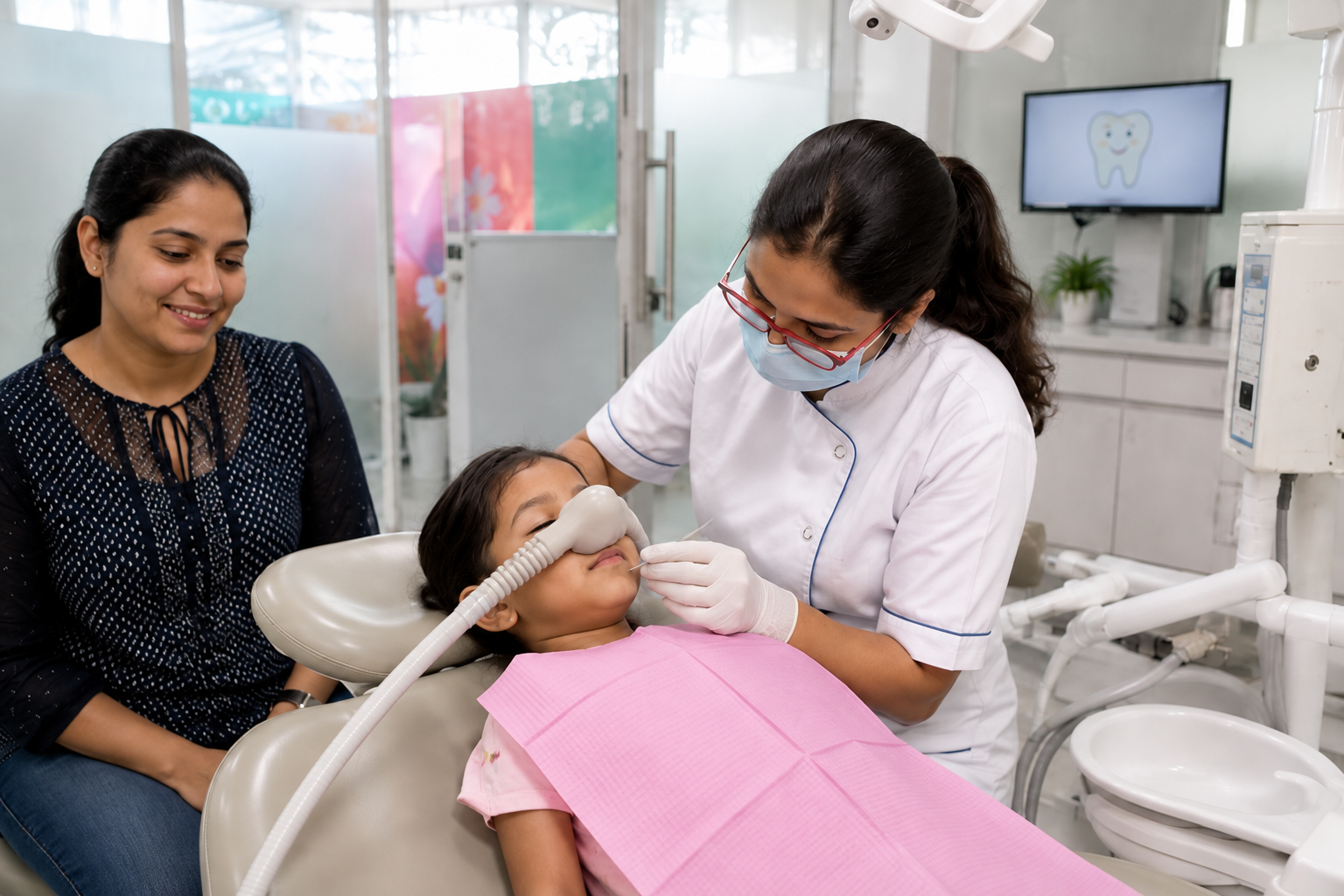
Nitrous Oxide (Laughing Gas)
Level: Minimal sedation child remains fully conscious and cooperative.
How it works: A small mask over the nose delivers a mixture of nitrous oxide and oxygen. The child feels relaxed, tingly, and slightly euphoric but can still respond to instructions and open their mouth on request.
Duration: Effect wears off within 5 minutes of stopping the gas. Child can resume normal activities immediately.
Best for: Mild anxiety, shorter procedures, children aged 4+.
Safety: Extremely well-established safety profile with 50+ years of clinical use. No residual effects.
Oral Sedation (Midazolam)
Level: Moderate sedation child is drowsy but conscious, may not remember the procedure.
How it works: A liquid medication given orally 30–45 minutes before treatment. The child becomes relaxed and sleepy, making treatment far easier for everyone.
Duration: Effects last 1–3 hours. Child needs a responsible adult to drive home and must rest for several hours.
Best for: Moderate anxiety, children aged 2–10 needing 2–4 fillings, SEN children.
Safety: Requires fasting (no food/drink for 4–6 hours before), monitoring throughout, and experienced personnel. Standard protocol at NABH-accredited facilities.
IV Sedation
Level: Deep sedation child is deeply relaxed, may be unresponsive, will not remember treatment.
How it works: Sedation medications delivered directly into a vein by an anaesthesiologist. Precise control of depth. Child appears to be sleeping but is not under general anaesthesia protective reflexes are maintained.
Best for: Extensive treatment, severe anxiety, SEN children with significant behavioural challenges.
Safety: Requires anaesthesiologist, full monitoring equipment, and recovery area. Available at select accredited centres.
General Anaesthesia (GA)
Level: Complete unconsciousness.
How it works: Administered by an anaesthesiologist in a hospital setting. Child is completely unconscious and all protective reflexes are suppressed.
Best for: Very young children (under 3) with extensive decay, children with severe medical/developmental conditions, cases where extensive treatment must be completed in one session.
Safety: Highest-risk option (though still extremely safe in healthy children) reserved for cases where benefits clearly outweigh risks. Full preoperative evaluation required.
Planning Sedation Treatment as an NRI Family
If you are visiting India from abroad and anticipate your child may need sedation dentistry, here is how to plan effectively:
- Send records in advance. Share previous dental X-rays, dental history, and any relevant medical history at least 2 weeks before your arrival. This allows us to plan treatment precisely and prepare for sedation if needed.
- Allow for a consultation visit. Sedation is never done at the first appointment. We need to evaluate your child clinically, assess their anxiety level, review medical history, and give you time to ask all your questions.
- Plan around the sedation day. Book the sedation appointment mid-visit so there's time both for the consultation before and for any follow-up treatment after. Clear the rest of the sedation day your child will need to rest.
- Fasting requirements. For oral sedation and above, children must fast for 4–6 hours before treatment. We'll give you precise instructions based on the type of sedation chosen.
- Have a companion. One parent needs to be available for the entire duration of treatment and recovery. The other parent can accompany siblings elsewhere if needed.
Before any sedation, we require a complete medical history including all medications, allergies, previous anaesthetic reactions, heart/respiratory conditions, and sleep apnea history. If your child has any complex medical conditions, please inform us before scheduling so we can coordinate with appropriate specialists.
We offer nitrous oxide sedation and oral sedation (midazolam) at our clinic with full monitoring. For IV sedation and GA, we work with a partner hospital and anaesthesiology team. All sedation at our facility is performed in compliance with Indian Dental Association protocols, with GA conducted in fully equipped NABH-accredited partner hospitals.
Contact us at +91 99452 25971 or visit our NRI Care page to begin planning your child's dental visit. We recommend initiating contact at least 4–6 weeks before your India trip to allow adequate preparation time.