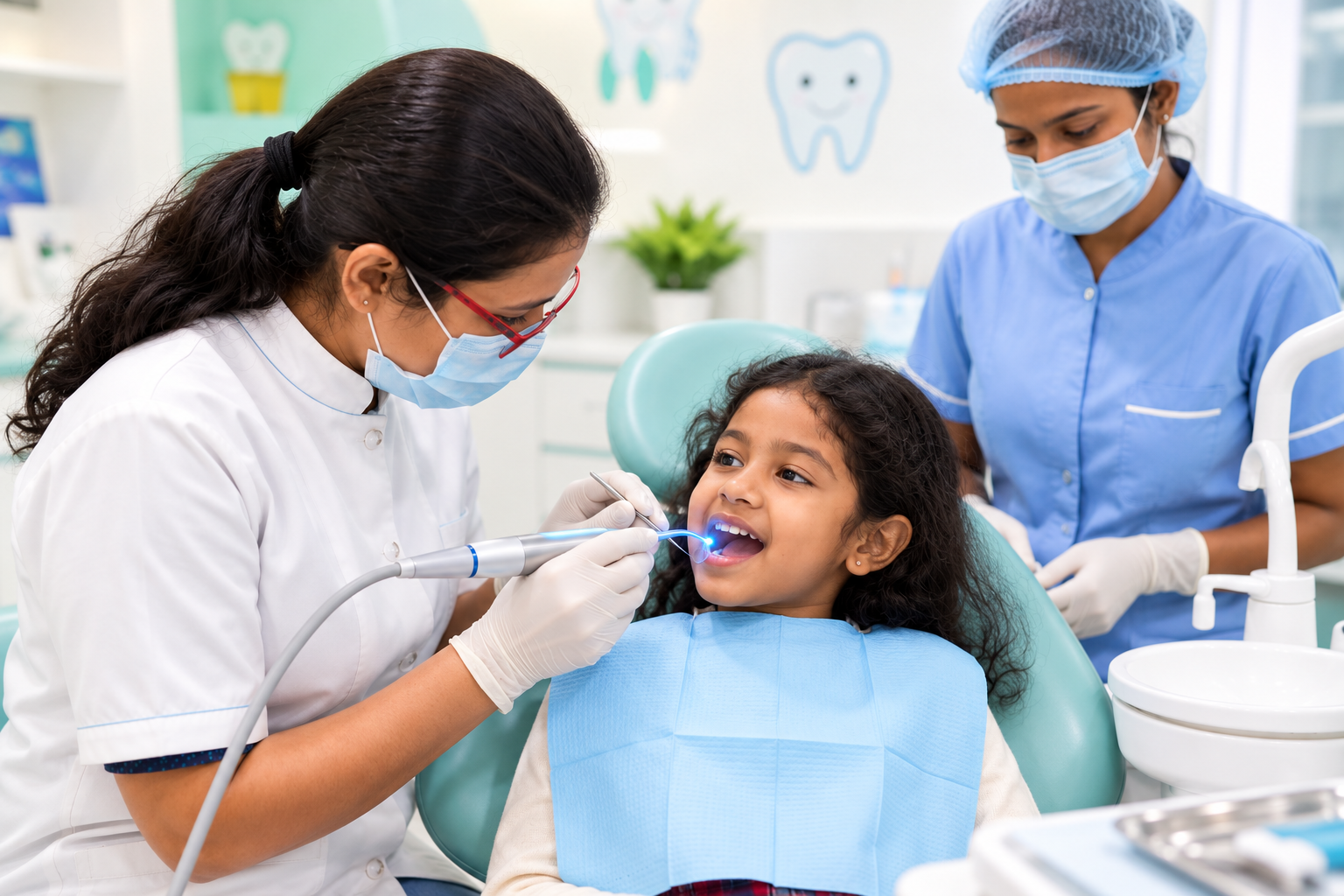
LASER dentistry in Bangalore is offered by a growing number of clinics — but the range of what "LASER dentistry" means in practice varies widely. At Dr. Mittal's clinic, LASER is used daily across a specific set of procedures where it produces meaningfully better outcomes for children than conventional methods. This article explains what that actually means.
What Is Dental LASER, Exactly?
A dental LASER delivers concentrated light energy to tissue — either removing, cutting, or biostimulating it with precision that a scalpel cannot match. Different types of LASERs are used for different tissues: soft tissue LASERs (like diode LASER) work on gums and mucosa; erbium LASERs work on both hard and soft tissue including dentine.
The reason LASER is particularly valuable in paediatric dentistry is the combination of precision, reduced bleeding, no sutures required, and faster healing — all of which matter enormously for children, who are more sensitive to post-procedure discomfort and more difficult to manage during complex recoveries.
LASER dentistry is not regulated in India in the same way as specialist qualifications — any dentist can purchase a unit. Dr. Mittal holds a formal LASER dentistry certification and has used LASER daily in clinical practice for over a decade. This is the difference between certification and equipment ownership.
LASER Procedures We Perform for Children
Tongue Tie (Lingual Frenectomy)
LASER frenectomy for tongue tie is performed in 10 to 15 minutes with topical anaesthesia in most children. No general anaesthesia, no sutures, minimal bleeding, and same-day feeding resumption for infants. Healing is typically complete in 5 to 7 days. Compared to scissor release, LASER has lower re-attachment risk and better precision for the posterior tongue tie that scissor techniques often miss.
Lip Tie (Labial Frenectomy)
Lip tie release is similarly fast and suture-free. For infants with breastfeeding difficulty, the combination of tongue tie and lip tie release at the same appointment is standard. Post-operative stretching exercises are critical — we provide written instructions and follow up at 1 week and 4 weeks.
LASER-Assisted Root Canal
LASER energy delivered into the root canal improves disinfection in the complex branching anatomy of primary teeth — where irrigants alone cannot reach. The result is better bacterial reduction and lower re-infection risk. For a tooth that would otherwise be extracted, LASER-assisted pulp therapy significantly improves the prognosis.
Soft Tissue Procedures
Gingivectomy (reshaping overgrown gums — common in adolescents on certain medications), operculectomy (removing tissue over a partially erupted molar), LANAP (laser-assisted gum regeneration for advanced gum disease) — all done without scalpel, without sutures, with faster healing and less post-operative discomfort.
Is LASER Safe for Children?
Yes — with appropriate protective eyewear, correct power settings for the tissue type, and a certified operator. Dental LASERs are non-ionising radiation (unlike X-rays). The energy is confined to the target tissue. The main safety requirement is proper eye protection, which is provided to the child, parent, and all staff in the room for every procedure.