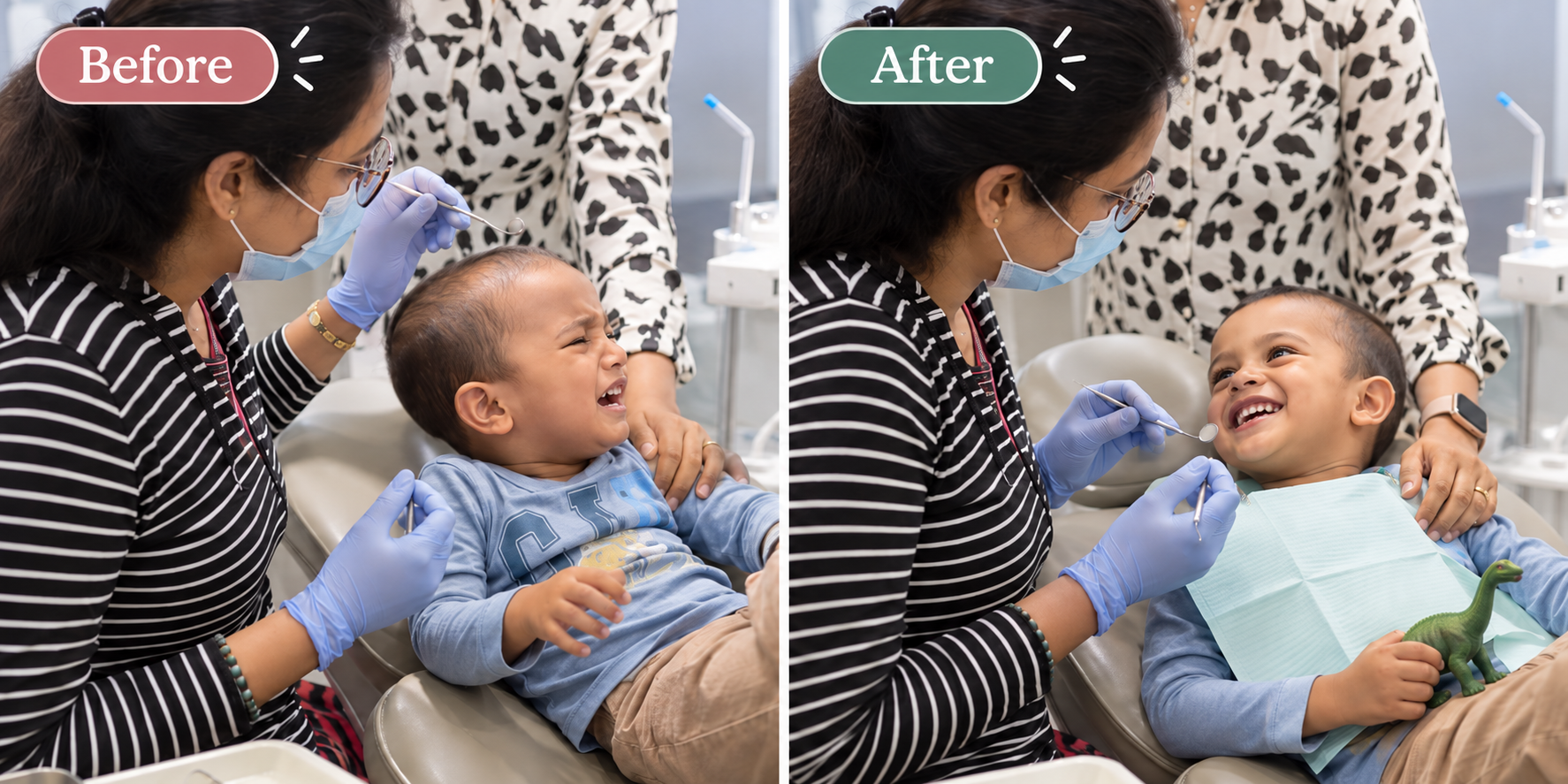
Where Dental Anxiety Comes From
Dental anxiety in children rarely appears out of nowhere. In my 18+ years of practice, I have traced the origins of almost every anxious child back to one of a handful of predictable sources and the most common one surprises parents: they created it themselves, without realising it.
Children are extraordinarily sensitive to the emotional states and verbal cues of the adults they trust. When a parent says something well-intentioned like "Don't worry, it won't hurt too much" or "Be brave it's just a small needle," the child doesn't hear reassurance. They hear confirmation that something painful is about to happen. The anxiety is set before the child has even sat in the dental chair.
Other common origins of dental anxiety include:
- A previous negative dental experience (often at a clinic not specialised in pediatric care)
- Overhearing parents or older siblings describe dental visits negatively
- Exposure to exaggerated dental fear in movies, cartoons, or jokes
- A general predisposition to anxiety or sensory sensitivity
- The first dental visit happening too late when the child is already in pain
"If you don't brush your teeth, the dentist will drill them!" This is one of the most damaging things a parent can say. It teaches children to associate the dentist with punishment and pain. This single phrase can create dental anxiety that lasts decades. The dentist must be framed as a friendly helper, not a consequence.
The Language That Creates Fear
Words matter enormously. Here is a direct comparison of language that creates anxiety versus language that builds comfort:
- "It won't hurt" / "It might hurt a little"
- "Pain" / "Shot" / "Needle"
- "Drill" / "Extraction"
- "Don't be scared"
- "Be brave" / "Don't cry"
- "Just a little prick"
- "The dentist will count your teeth"
- "Sleepy juice" / "Magic wand"
- "Tooth tickler" / "Tooth helper"
- "It's going to feel interesting"
- "You're doing such a great job"
- "Almost done you're so strong"
In pediatric dentistry, we are trained to use what we call "euphemistic language" child-friendly descriptions of procedures that are accurate but frame everything in non-threatening terms. We ask parents to do the same in the days before an appointment.
Before the Visit: Preparing Your Child
How you talk about the upcoming dental visit in the days before it happens is critically important. Here is what works:
Do
- Keep the explanation simple and positive. "We're going to visit Dr. Mittal, who will count your teeth and make sure they're super healthy."
- Read age-appropriate books about dental visits. There are many excellent children's books that frame the dentist as a positive, fun experience.
- Play "dentist" at home. Let your child "examine" your teeth with a torch, count them, and then let them be the patient. Familiarity with the concept reduces fear of the unknown.
- Answer questions honestly but simply. "Will it hurt?" can be answered with: "Some things might feel a bit different or tickly, but the dentist is very gentle and will always tell you what's happening first."
- Plan something enjoyable for after the appointment. A visit to the park, a favourite meal a positive association for the post-visit period.
Don't
- Tell your child "don't be scared" this confirms there is something to be scared of
- Share your own dental anxieties with your child
- Bribe with sweets (ironic) or make elaborate promises that imply the visit will be terrible
- Surprise a child with a dental visit always give advance notice
At the Clinic: What to Expect From Us
At Dr. Mittal's Kids & Family Dental, every aspect of our environment and approach is designed to reduce anxiety in children. From the moment you walk in, you'll notice:
- A colourful, child-friendly waiting area with activities, books, and a calm atmosphere
- Staff trained specifically in pediatric communication and behaviour management
- Treatment rooms with familiar elements child-sized chairs, ceiling art or screens to look at during treatment
- A "no surprise" policy we explain everything we're going to do before we do it
- A stop signal system every child is told they can raise their hand to pause treatment at any time
We also make time at the first visit simply to familiarise the child with the environment before any clinical work is done. For very young or anxious children, the first visit may involve nothing more than meeting the team, sitting in the chair, and getting a small reward building positive association before any treatment begins.
Tell-Show-Do: How We Approach Every Anxious Child
Tell-Show-Do is the gold standard technique in pediatric dentistry for managing child anxiety, and it is the foundation of every interaction at our clinic.
- Tell: We describe what we're going to do in simple, age-appropriate language. "I'm going to use this little brush to clean your teeth it tickles a bit and makes a funny noise."
- Show: We demonstrate on the child's finger, on a model, or by letting them see and touch the instrument before it goes near their mouth.
- Do: We perform the procedure, moving slowly, narrating, and checking in continuously.
This approach gives children a sense of control and predictability. They know what's coming. Nothing is a surprise. The hand-raise stop signal reinforces that they have agency over what happens to them and paradoxically, children who feel in control rarely use it.
A child who has positive early dental experiences becomes an adult who attends dental appointments without anxiety, gets problems treated early, and maintains good dental health throughout their life. A child who is traumatised by early dental experiences may avoid dentists for decades sometimes until a dental emergency forces them back. The investment in making early visits positive has lifelong returns.
Sedation Options for Highly Anxious Children
For children with severe dental anxiety, or those requiring extensive treatment who cannot cooperate despite all behaviour management techniques, sedation is a safe and effective option. At Dr. Mittal's, we offer:
- Nitrous oxide (laughing gas): A mild, extremely safe sedative delivered through a small mask. The child remains fully awake and responsive but relaxed and less aware of anxiety. It wears off within minutes of the mask being removed. This is our most commonly used option for anxious children aged 4 and above.
- Oral sedation: A sedative medication given by mouth before treatment. The child becomes drowsy and relaxed but remains conscious. Suitable for older children with moderate anxiety.
- General anaesthesia: For very young children, children with special needs, or those requiring extensive dental work who cannot cooperate with conscious sedation. Performed in a hospital or day-surgery setting with a paediatric anaesthetist.
Sedation is never our first resort we always try behavioural techniques first. But when it is appropriate, it allows us to complete necessary treatment safely, and often the positive experience under sedation actually reduces future anxiety.
When to Seek Additional Help
In rare cases, dental anxiety is part of a broader anxiety disorder that benefits from additional professional support. Signs that your child's dental anxiety may warrant evaluation by a child psychologist include:
- Physical symptoms (vomiting, panic attacks) at the mention of dental visits
- Anxiety that significantly disrupts daily life or sleep in the days before an appointment
- A pattern of severe anxiety about multiple medical settings, not just dental
If you are concerned, we are happy to provide a referral to a child psychologist we trust, who can work with your child using cognitive behavioural techniques specifically designed for medical/dental anxiety.
If your child has had a difficult dental experience elsewhere, or if you're worried about how they'll respond to their first visit, please let us know when you call. We will take extra time, move at your child's pace, and build a positive relationship before any clinical work begins. Call +91 99452 25971 or book a gentle first visit.