Call +91 99452 25971 immediately. A dental abscess with fever or facial swelling cannot wait same-day treatment is essential.
When children complain of tooth pain, parents often assume it is a cavity or a loose tooth. But if your child has been in persistent, throbbing pain especially if there is any swelling of the face, fever, or a bad taste in their mouth there is a real possibility they have a dental abscess. This is one of the most serious dental conditions a child can develop, and it demands prompt professional attention.
Unlike a simple toothache, a dental abscess is an active bacterial infection. Left untreated, it does not simply go away. The infection can spread to the jaw bone, the neck, and in rare but documented cases, to the brain. Understanding what an abscess looks like, and knowing when it has crossed into emergency territory, could genuinely protect your child's life.
What Is a Dental Abscess?
A dental abscess is a pocket of pus a collection of bacteria, dead tissue, and white blood cells that forms as the body tries to contain a bacterial infection. In children, dental abscesses most commonly arise from two causes:
Periapical Abscess (Root Abscess)
This is the most common type. It forms at the tip of the tooth's root when bacteria from deep, untreated tooth decay (or from a cracked or broken tooth) invade the pulp the soft tissue containing the tooth's nerve and blood supply. Once the pulp is infected, bacteria travel down to the root tip and begin infecting the surrounding bone and tissue, forming a pus pocket.
Periodontal Abscess (Gum Abscess)
This type forms in the gum tissue beside a tooth, often when food or debris becomes trapped in a deep pocket between the tooth and the gum. In children, this is less common than periapical abscesses but can occur, particularly in children with poor oral hygiene or crowded teeth where cleaning is difficult.
The root cause in both cases is bacteria and the underlying driver in most paediatric cases is untreated tooth decay. This is why regular dental check-ups and treating cavities promptly (even in baby teeth) are so critical. A cavity that might have been treated with a small filling at age 4 can become an abscess requiring hospitalisation by age 6 if ignored.
Warning Signs to Watch For
A dental abscess in a child can develop quickly sometimes over 24 to 48 hours. Knowing the signs means you can act before it becomes dangerous. Look for any combination of the following:
- Severe, throbbing toothache that is persistent and does not improve or may actually worsen over time. Unlike a typical cavity pain that comes and goes, abscess pain tends to be relentless.
- Facial swelling especially if one cheek or side of the jaw appears puffy, firm to the touch, or the swelling is spreading toward the eye or neck. This is a red flag that requires urgent attention.
- Fever above 38°C (100.4°F) any fever in combination with dental pain and swelling should be treated as an emergency. Fever signals the infection has triggered a systemic immune response.
- A bad taste or foul smell in the mouth this often means the abscess has ruptured and is draining into the mouth. While this may temporarily reduce pain, it does not mean the infection is gone. It still requires treatment.
- Difficulty opening the mouth (trismus) if the infection has spread to the muscles of the jaw, your child may not be able to open their mouth fully. This is an advanced sign of spreading infection.
- Difficulty swallowing or breathing this is an extreme emergency. Go to the nearest hospital emergency room immediately. Do not wait for a dental appointment.
- Swollen or tender lymph nodes under the jaw or in the neck, which indicate the lymphatic system is fighting a spreading infection.
- A small pimple-like bump (dental sinus/fistula) on the gum near the base of a tooth this is a drainage tract from a chronic abscess. It may not be painful, but it indicates ongoing infection that needs treatment.
Your child has facial swelling with fever and cannot swallow or breathe normally, or if swelling is spreading to the neck or closing the eye. Do not wait for the dentist go directly to the nearest hospital emergency department and call us from there: +91 99452 25971.
Why It's a Medical Emergency
The mouth and jaw are anatomically close to vital structures the airway, major blood vessels, and the brain. While a dental abscess that stays localised to a single tooth is serious but manageable, an infection that spreads can escalate to life-threatening conditions with alarming speed, particularly in children whose immune systems may be less equipped to contain aggressive bacterial spread.
Osteomyelitis of the Jaw
When infection from an abscessed tooth spreads into the surrounding jaw bone, it causes osteomyelitis a bone infection. This requires prolonged antibiotic treatment and sometimes surgical debridement (removal of infected bone tissue). It can permanently damage the jaw and disrupt the development of nearby permanent teeth.
Ludwig's Angina
This is a rapidly spreading cellulitis (deep tissue infection) of the floor of the mouth and the neck. It can cause swelling that compresses the airway from below, leading to difficulty breathing and, if untreated, asphyxiation. Ludwig's angina requires immediate hospitalisation, intravenous antibiotics, and often surgical drainage. While this condition is rare, it is associated with lower molar abscesses and has been reported in children.
Cavernous Sinus Thrombosis
An extremely rare but life-threatening complication where infection travels from the upper jaw upward through venous channels to the cavernous sinus a large vein at the base of the brain. Symptoms include high fever, severe headache, eye protrusion, and visual changes. This requires emergency hospitalisation and is associated with significant mortality.
These complications are rare, and we share this information not to frighten parents but to explain clearly why a dental abscess especially one with fever or swelling must never be dismissed as "just a toothache." Early treatment prevents these outcomes entirely.
What NOT to Do
When your child has a suspected dental abscess, there are several actions that parents commonly try that can make the situation worse:
- Do not try to lance or pop the abscess at home. Puncturing an abscess without sterile conditions introduces additional bacteria and can spread infection into deeper tissue layers. This is extremely dangerous and must never be attempted.
- Do not give leftover antibiotics without a prescription. Many families have partially used antibiotic courses from previous illnesses and are tempted to give these to their child. This is harmful: the wrong antibiotic will not work against the specific bacteria causing the abscess, and incomplete dosing contributes to antibiotic resistance. Only use antibiotics prescribed specifically for this episode by your doctor or dentist.
- Do not wait and hope it resolves on its own. An abscess will not go away without treatment. Even if the pain temporarily eases (sometimes because the abscess has ruptured and is draining), the infection remains active. The tooth and surrounding bone continue to be damaged. Untreated abscesses that seem to "calm down" frequently return, often more aggressively.
- Do not apply heat to the swelling. Heat increases blood flow to the area, which can encourage the spread of infection. Use a cold compress (wrapped in cloth) for comfort relief only.
- Do not give aspirin to children. Aspirin is associated with Reye's syndrome in children under 18. Use age-appropriate doses of paracetamol for pain relief while awaiting dental care.
If your child has visible facial swelling combined with a fever and you cannot reach your dentist or it is outside clinic hours, do not wait until morning. Take your child to the nearest hospital emergency department immediately. A dental abscess with systemic signs is a medical emergency.
Treatment at the Clinic
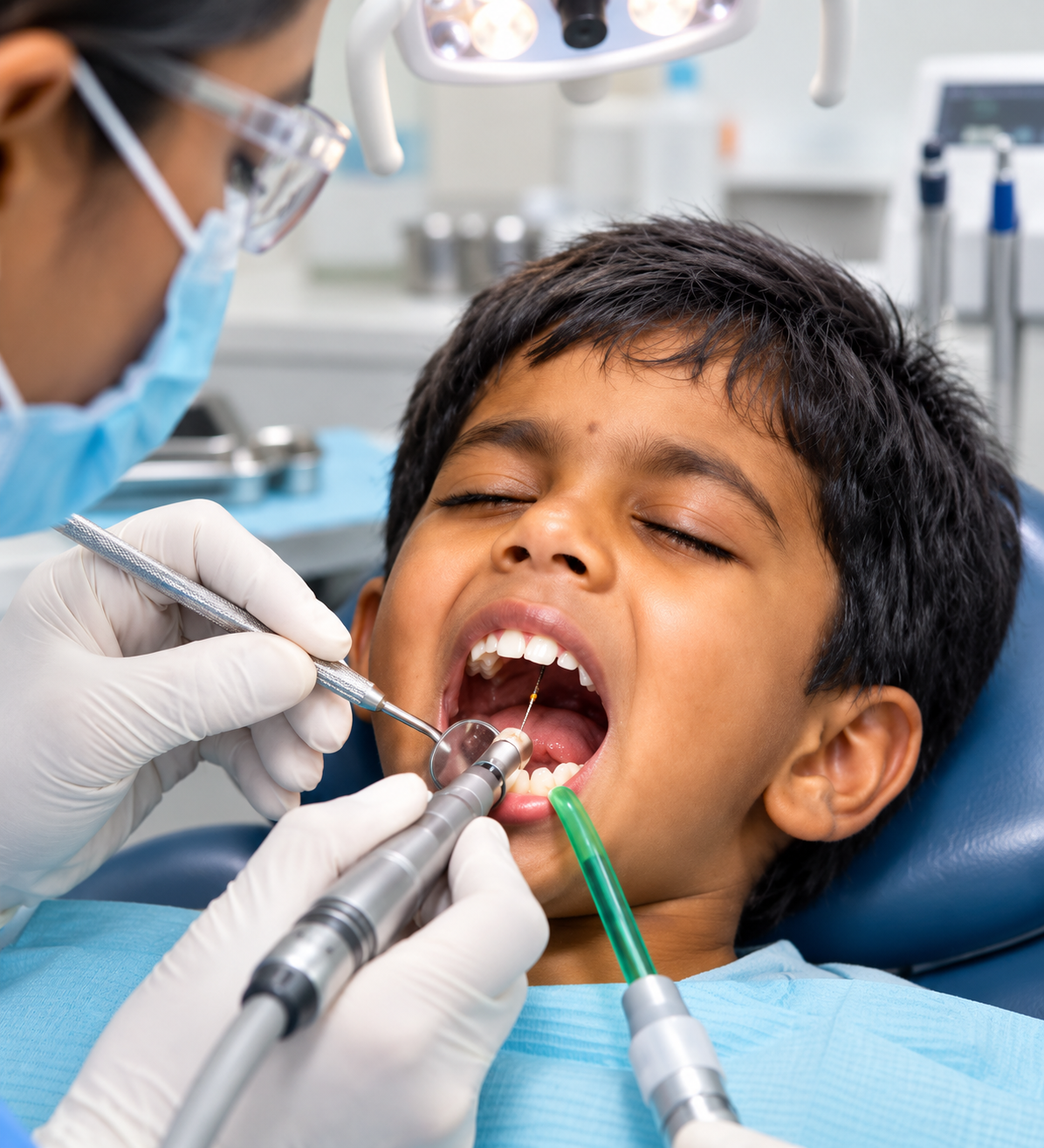
When you bring your child in with a suspected abscess, our approach is to relieve pain and infection as quickly as possible, while choosing the treatment that best preserves the tooth when feasible. Here is what to expect:
Diagnosis and Assessment
We will take a clinical history, examine the affected area, and take a dental X-ray. The X-ray allows us to see the extent of the infection at the root tip, assess how much bone has been affected, and determine whether the tooth is salvageable. We will also check the child's temperature and assess for any signs of spreading infection.
Drainage of the Abscess
The infected pus must be drained to relieve pressure and remove the bacterial load. This may be accomplished through an incision in the gum tissue (if the abscess is near the surface) or through the tooth itself by opening the tooth to allow drainage through the root canal. Local anaesthetic is used, and our team is experienced in making this process as gentle and comfortable as possible for children.
Antibiotics
Antibiotics are prescribed when there are signs of spreading infection, systemic involvement (fever), or significant swelling. Antibiotics alone cannot clear a dental abscess the source of infection (the tooth) must also be treated but they are an important part of controlling the bacterial load and preventing spread. Always complete the full prescribed course.
Root Canal Treatment (Pulpectomy) or Extraction
Once the acute infection is under control, the underlying cause must be addressed. If the tooth is structurally sound and the roots are not severely damaged, a root canal treatment (called a pulpectomy in children) cleans out the infected pulp, disinfects the canals, and seals the tooth so it can be retained. A crown is usually placed afterwards for protection.
If the tooth is not salvageable for example, if the roots are severely damaged, the bone loss is extensive, or the tooth has fractured below the gum line extraction may be necessary. If a baby tooth is extracted early, a space maintainer will be placed to preserve the space for the incoming permanent tooth.
Follow-Up Care
After acute treatment, follow-up appointments are essential to confirm healing, check that the infection has fully resolved, and monitor the affected area with X-rays over time. We will also review your child's oral hygiene and dietary habits to prevent recurrence.
Call +91 99452 25971 or book online. We prioritise emergencies same-day appointments available. Do not let a dental abscess wait.