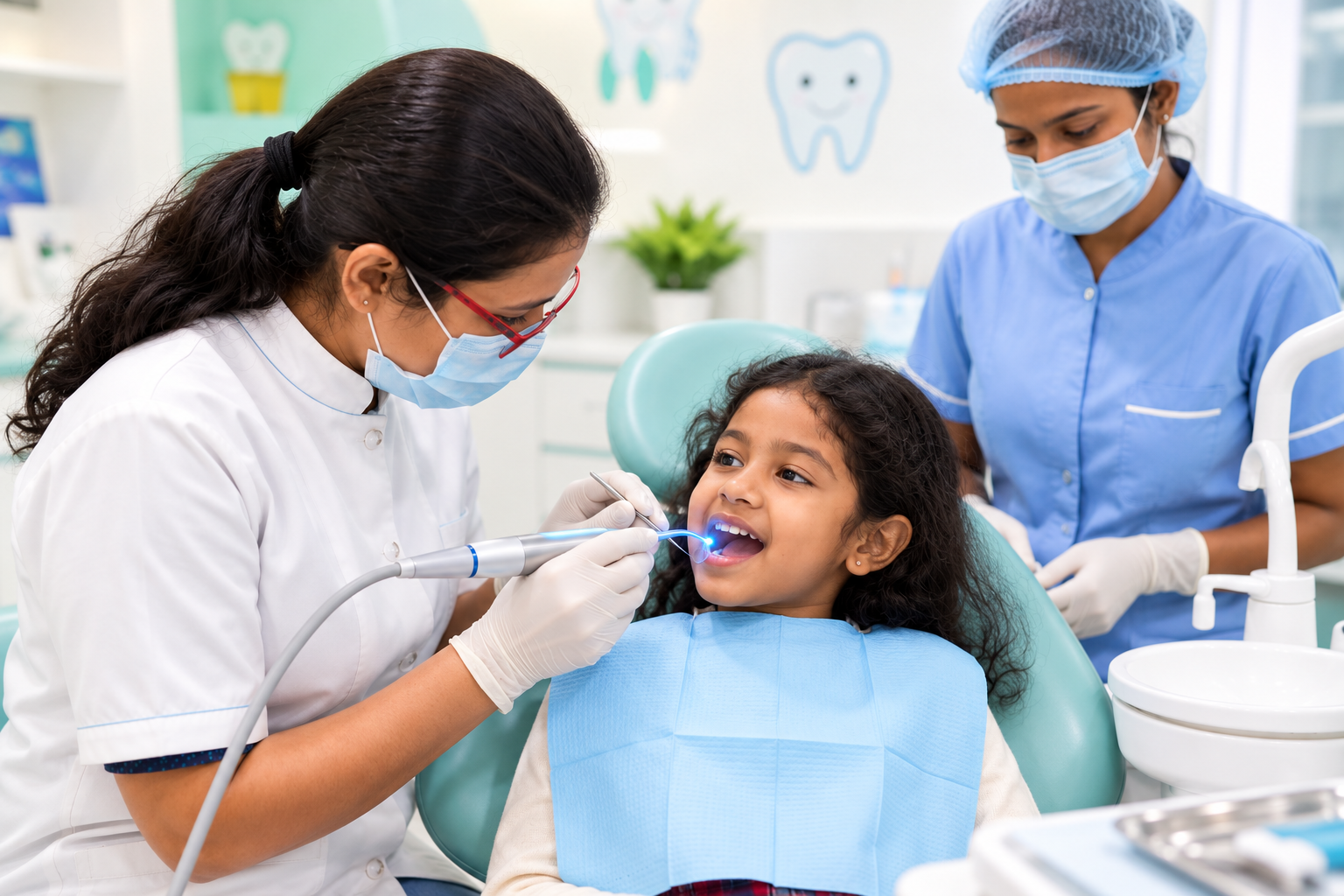
Searching for the best dentist in Bangalore for your child is not the same as searching for the best adult dentist. Children's dental needs are fundamentally different — developmentally, behaviourally, and clinically. This article sets out the framework for making that decision well.
What Sets a Children's Dental Specialist Apart
An MDS-qualified paediatric dentist has three years of postgraduate training specifically in child dental development, behaviour management, preventive dentistry, pulp therapy for primary teeth, early orthodontics, and special needs care. This depth is not achievable through general dentistry experience alone — it is a formal academic and clinical qualification.
In Bangalore, a significant proportion of clinics that advertise as "kids dental clinics" are staffed by BDS graduates. That is not a disqualification for routine care — but for complex or anxious children, the specialist gap matters.
The Checklist We Would Use to Choose
- MDS (Pediatric Dentistry) qualification — verifiable on the Dental Council of India portal.
- Conscious sedation capability — nitrous oxide and oral sedation for anxious children, administered with proper monitoring.
- Digital radiography — lower radiation, immediate images, better diagnosis.
- Behaviour management protocols — Tell-Show-Do, desensitisation, distraction, and positive reinforcement before any sedation is considered.
- Written treatment plan — you should leave the first visit knowing exactly what needs doing and in what order.
- LASER dentistry capability — for frenectomies, soft tissue procedures, and anxious patients where drill-free options exist.
- Special needs experience — ASD, CP, and Down syndrome require specific adaptations that a generalist may not be trained in.
MDS (Pediatric Dentistry), 18 years, Reg. 21969-A Karnataka State Dental Council. LASER certified. Conscious sedation certified. Two branches in Bengaluru — Banashankari and Chandra Layout.
What a Good First Visit Looks Like
A good first visit does two things: examines the child's teeth thoroughly and makes the child feel that the dentist is on their side. These are not in tension. A skilled paediatric dentist runs through a complete clinical assessment while the child barely notices — using distraction, narration, and pacing that is designed for children, not adapted from adult protocols.
You should receive a written treatment plan before leaving. If the first visit ends with "we'll see how it goes," that is not a treatment plan. If it ends with a clear list of what is needed, what is urgent, what can wait, and what the appointment sequence looks like — that is the standard you should expect.
Red Flags to Watch For
- Treating a child who is in distress without a behavioural de-escalation attempt
- Starting treatment at the first visit without any familiarisation
- Recommending extraction of baby teeth as the default for any decay
- No digital X-ray on-site (conventional film means higher radiation exposure)
- Inability to explain what the treatment involves in plain language
- Pressure to pay for a full treatment course before examining the child