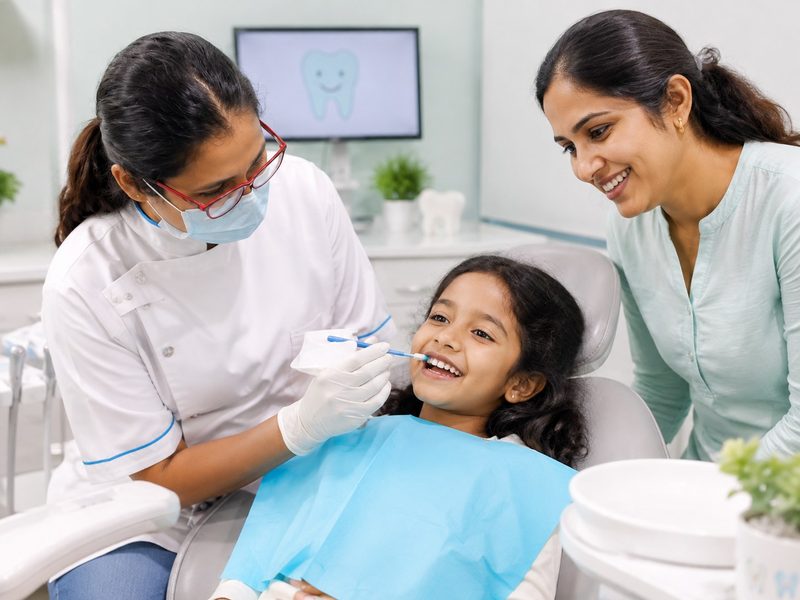
A dental checkup is not the same at every age. What we look for at 12 months is completely different from what we assess at 6 years, which is different again from what matters at 12. This guide lays out exactly what should happen at a proper paediatric dental examination — at each stage of development.
Why Regular Checkups Are Non-Negotiable
Dental disease in children is almost entirely preventable — but only if it is caught early. A cavity in its early stage (white spot lesion) can be reversed with fluoride. A small cavity can be filled in 20 minutes with no local anaesthetic. A large cavity that has reached the pulp requires pulp treatment, a crown, and a much longer appointment. The same biology, very different outcomes — separated by one missed 6-month check.
Beyond decay, checkups at the right age identify tongue tie before speech is affected, jaw development issues before growth stops, and habit-related damage (thumb sucking, mouth breathing) before it becomes structural. The checkup is where prevention happens.
The Indian Society of Paedodontics and Preventive Dentistry recommends the first dental visit by 12 months. The earlier we see a child, the better the preventive baseline we can establish.
What We Check at Each Age
0–12 Months (Infant Assessment)
Tongue tie and lip tie assessment — often the same week as birth if breastfeeding difficulties are reported. Gum health, the emergence of first teeth, oral hygiene guidance for parents, and early dietary counselling (no juice, no bottles at bedtime). Jaw symmetry and palate shape are noted as a baseline.
1–3 Years (Toddler)
By now, all 20 primary teeth should be erupting or erupted. We check for early childhood caries (ECC) — a pattern of rapid decay that affects the upper front teeth first. We assess oral habits (thumb sucking, pacifier use), fluoride exposure, and dietary patterns. Knee-to-knee examination with the parent holding the child is standard at this age.
4–6 Years (Pre-School)
First visit to the full dental chair for most children. X-rays between back teeth are taken if teeth are touching — this is where interproximal decay hides and is invisible without imaging. Fluoride varnish and pit-fissure sealants on first permanent molars (which emerge around age 6) are discussed. Space maintainers are planned if baby teeth have been lost early.
7–9 Years (Mixed Dentition)
The most critical orthodontic assessment window. Permanent incisors and first molars have erupted — we assess jaw width, crossbite, crowding, and the alignment of the bite. Phase 1 orthodontic intervention is planned here for cases where early action prevents more invasive treatment later. Oral hygiene technique is reviewed: children under 8 need parental brushing, not just supervision.
10–13 Years (Adolescence Approach)
Most permanent teeth are in by 12, including second molars. This is the ideal window for comprehensive orthodontic treatment if Phase 1 is complete or not needed. We assess gum health — teenagers are prone to gingivitis due to hormonal changes — and continue to monitor wisdom tooth development on X-ray.
14–18 Years (Teen)
Orthodontic retention (retainers are for life), wisdom tooth monitoring, athletic mouthguard fitting for contact sport participants, and transition planning to adult dental care. Many teenagers also request tooth whitening — we counsel on what is appropriate and safe at this age.